Pelvis (Latin: pelvis)
Also called the bony pelvis
- Overview
- Greater and lesser pelvis
- Sex differences
- Development
- Reference websites
- (Wikipedia)
- YouTube
- Where it is found
- Related terms
Overview
[What is the pelvis?]
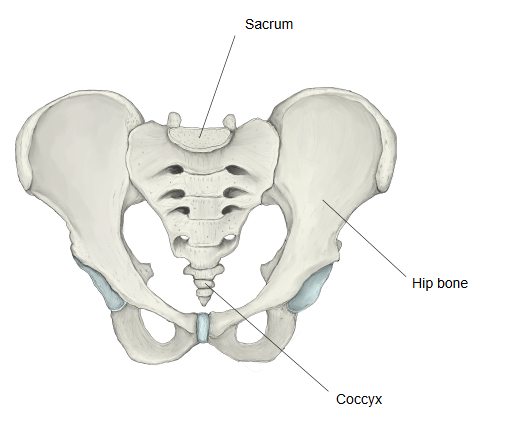
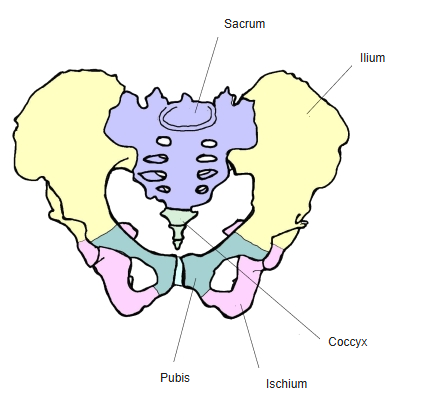
- Hip bone : one on each side; each is made of the ilium pubis ischium fused together.
- Sacrum : five sacral vertebrae fused together; it lies between the two hip bones, joined to them at the sacroiliac joints.
- Coccyx : three to five coccygeal vertebrae fused together; joined to the lower end of the sacrum.
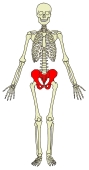 Skeleton (anterior)
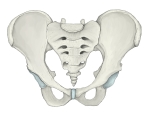 Pelvis (anterior)
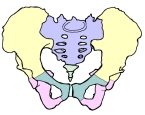 Bones of the pelvis
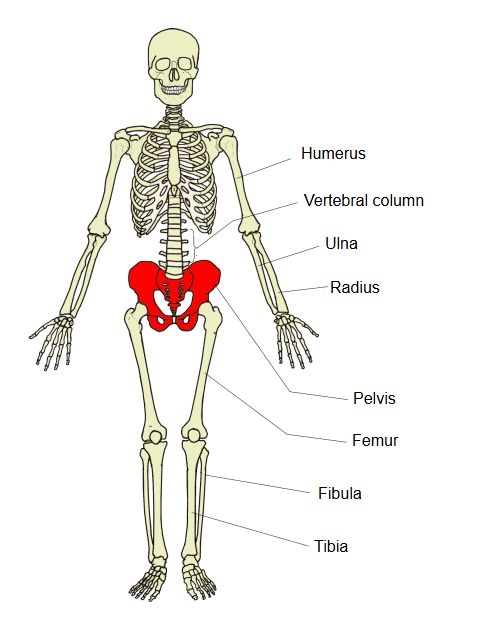
Greater and lesser pelvis
The space enclosed by the pelvis is divided by the pelvic brim (linea terminalis) into the upper greater pelvis and the lower lesser pelvis. The brim runs from the promontory of the sacrum along the arcuate line and pecten pubis to the top of the pubic symphysis.
| 1 | Greater pelvis | greater pelvis (false pelvis) The part above the pelvic brim; it is the lowest part of the abdominal cavity and holds abdominal organs. Its side walls are the alae of the ilium; behind, it is bounded by the upper sacrum, the lower lumbar vertebrae and the ligaments between them and the iliac crest; in front it is open (closed only by the abdominal wall). | 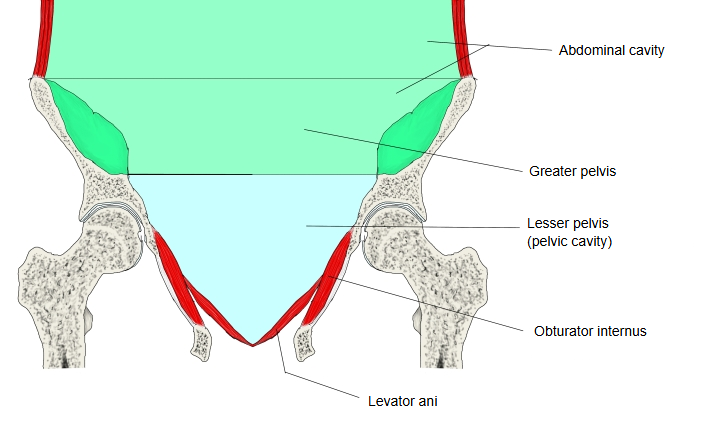 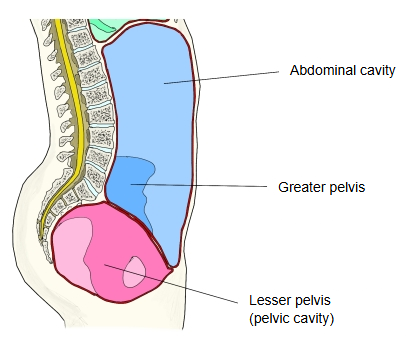 |
| 2 | Lesser pelvis | lesser pelvis (true pelvis) The part below the pelvic brim, also called the pelvic cavity; it holds the pelvic organs (bladder, rectum, internal reproductive organs). Its walls are the sacrum and coccyx behind, the hip bones (ischium and pubis) at the sides and in front, with the obturator membrane and the sacrospinous and sacrotuberous ligaments. It opens above at the pelvic inlet and below at the pelvic outlet, which is closed by the pelvic floor. |
Sex differences
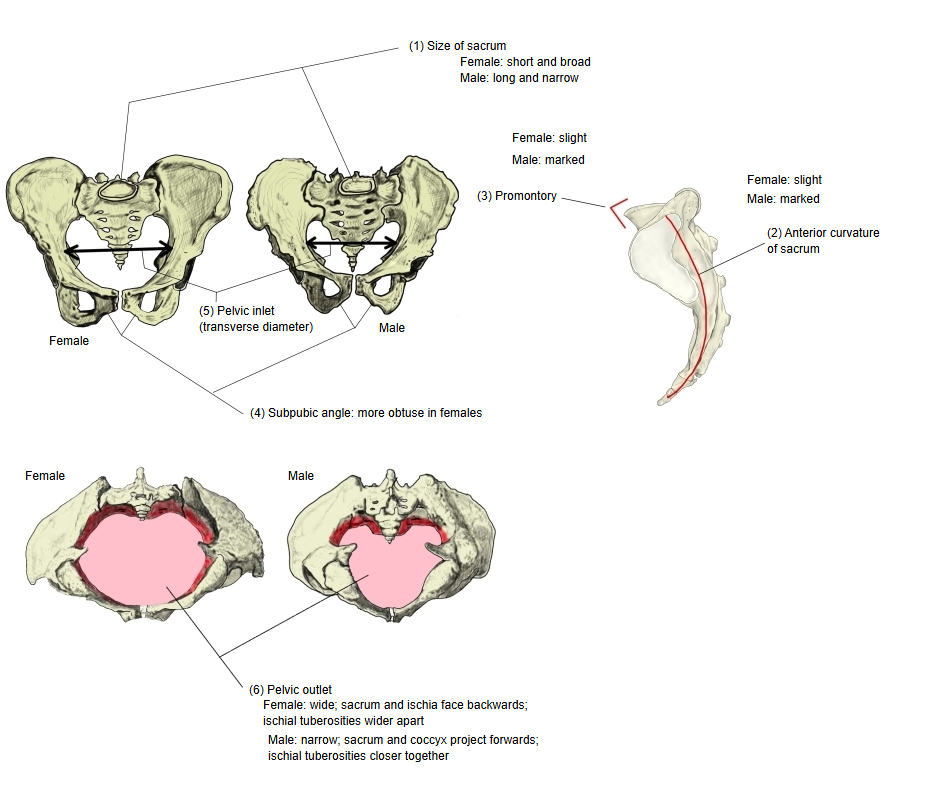
The size and shape of the pelvis differ between women and men. The table and figure below summarize the main differences; note that the proportions between views, and between the female and male drawings, are only approximate.
| Feature | Female | Male | |
|---|---|---|---|
| 1 | Size of the sacrum | Short and wide | Long and narrow |
| 2 | Forward curvature of the sacrum | Slight | Strong |
| 3 | Promontory | Projects only slightly | Projects strongly |
| 4 | Subpubic angle | Obtuse (wide) | Acute (narrow) |
| 5 | Pelvic inlet (transverse diameter) | Large, more rounded | Small, heart-shaped |
| 6 | Pelvic outlet | Wide; the sacrum and coccyx point further back, and the ischial tuberosities are further apart | Narrow; the sacrum and coccyx project further forward, and the ischial tuberosities are closer together |
| 7 | Pelvic floor | Low and wide | Funnel-shaped, narrowing downward |
Development
· Each hip bone forms in cartilage and ossifies from three main centres - ilium, ischium and pubis - which stay separate in childhood and meet at the acetabulum in a Y-shaped (triradiate) cartilage; they fuse in the mid-teens. In the newborn the pelvis is very small and the pelvic cavity narrow; the sacrum is relatively large but the promontory is weak, the iliac alae are only slightly spread and the two obturator foramina lie close together. The shape changes as the lower limbs grow, but sex differences appear only at about ten years of age, and the typical female form is completed after puberty.
Reference websites
[Wikipedia]
· Pelvis, Wikipedia.
YouTube
· Anatomy of the pelvis - everything you need to know - Dr. Nabil Ebraheim (3:58)
Where it is found
Related terms
References and sources
- Further reading: Pelvis, Wikipedia.
- Federative International Programme for Anatomical Terminology (FIPAT). Terminologia Anatomica, 2nd ed. (TA2), 2019.