Perforating fibres (Latin: fibrae perforantes)
Also called Sharpey's fibres (Sharpey's fibers) or bone fibres
Perforating fibres (Sharpey's fibres)
Periosteum and bone
 Structure of compact bone
 Periosteum and bone
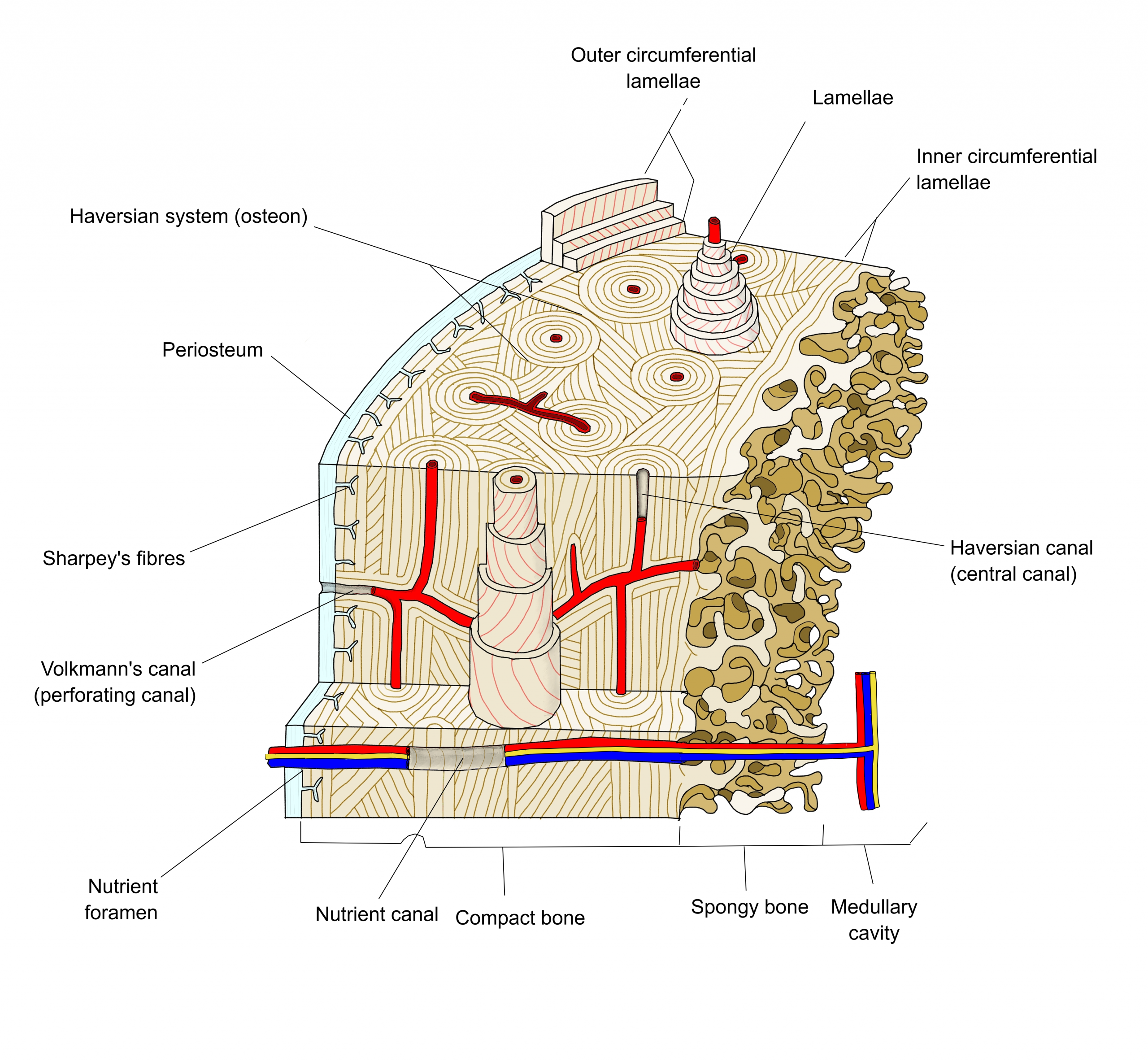
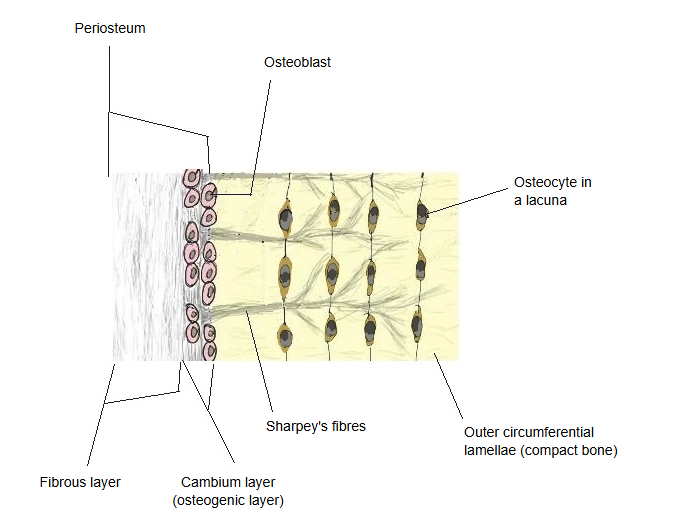
Tendons and ligaments: at many attachments the collagen of a tendon or ligament continues into the bone as perforating fibres, for example where the rotator cuff muscles attach to the scapula.
Reference websites
[Wikipedia]
· Sharpey's fibres, Wikipedia.
[Websites with illustrations]
· Skeleton (slide with Sharpey's fibres) (SlideShare)

· Periodontium (diagram) (Wikimedia Commons)

Periodontal ligament and tooth
The principal fibres of the periodontal ligament are collagen fibres whose two ends are perforating fibres: they are embedded in the cementum of the root on one side and in the alveolar bone on the other, holding the tooth in its socket. In acellular cementum they are fully mineralized; in cellular cementum and bone only at their periphery.
They are named after the Scottish anatomist William Sharpey.
Related terms
- Periosteum
- Fibrous layer of periosteum
- Outer circumferential lamellae
- Periodontal ligament
- Acellular cementum
- Alveolar bone
- Tendon
References and sources
- Further reading: Sharpey's fibres, Wikipedia.
- Federative International Programme for Anatomical Terminology (FIPAT). Terminologia Anatomica, 2nd ed. (TA2), 2019.