Gustatory cell (Latin: epitheliocytus gustatorius)
Also called Taste cell or the taste receptor cell
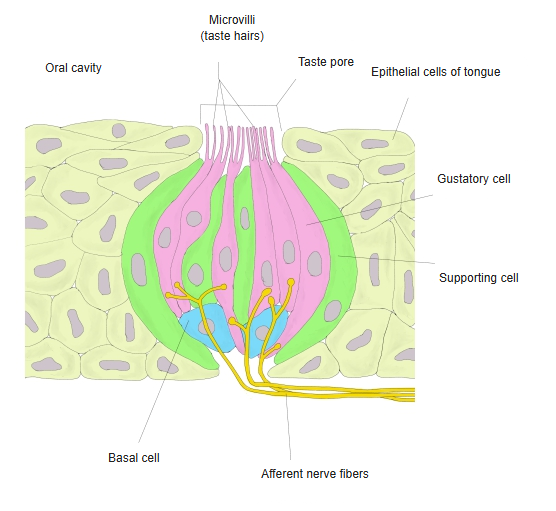
The gustatory cell is one of the cells that make up a taste bud: a sensory epithelial cell that senses taste, lying between the supporting cells.
Taste buds are found mainly on the tongue, and in smaller numbers on the soft palate, the pharynx and the epiglottisSee gustatory cells
The free end of the gustatory cell carries microvilli (small processes called gustatory hairs), which project into the taste pore.
Taste pore: the narrow opening of the taste bud towards the surface of the oral cavity
| Cell | Description | |
|---|---|---|
| 1 | Gustatory cell | A pale cell whose free end carries small processes, microvilli called gustatory hairs, that project into the taste pore. It is the sensory epithelial cell that senses taste; it lies between the supporting cells and forms typical synapses with the nerve endings that reach the taste bud (type III). |
| 2 | Supporting cells | Two kinds are told apart. The dark cells lie mainly at the edge of the taste bud and contain secretory granules (type I); they appear to have glia-like functions. The light cells lie further inside and are linked with nerve endings (type II); they carry receptors for sweet, bitter and umami substances and are now counted as taste receptor cells too. Both have long microvilli. Sources differ on how the cell types are named. |
| 3 | Basal cells | Short cells at the base of the taste bud (type IV) that do not reach the taste pore. There are only a few in each taste bud; they are the progenitor cells from which the other cells of the taste bud are renewed. |
Reference websites
[Wikipedia]
· Taste bud, Wikipedia.
[Websites with illustrations]
· Taste buds, papillae and gustatory hairs (figure) (antranik.org)

· Taste bud (figure) (Neuroscience Online, UTHealth)
