Anatomical position
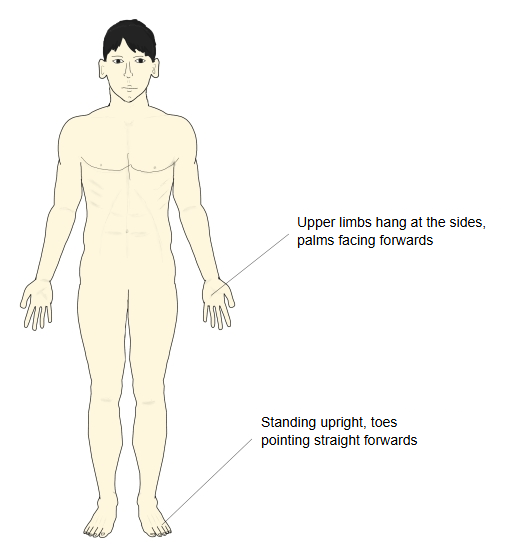
Anatomical position
In anatomy, the posture used as the basis for describing the planes, directions and positions of the body: standing upright with the toes pointing forwards and the arms hanging down at the sides with the palms facing forwards.
In this position the head and eyes face forwards, with the head held so that the lower edge of the orbit and the top of the external ear opening are level (the Frankfort plane). Because the palms face forwards, the two bones of the forearm lie side by side. Terms of relation such as anterior and posterior, medial and lateral, and superior and inferior always refer to the body in this position, whatever its actual posture.
Reference websites
[Wikipedia]
· Standard anatomical position, Wikipedia.
[Websites with illustrations]
· Anatomical position (images) (Wikimedia Commons)
· Anatomical terms of location (TeachMeAnatomy)
Related terms
References and sources
- Further reading: Standard anatomical position, Wikipedia.
- Federative International Programme for Anatomical Terminology (FIPAT). Terminologia Anatomica, 2nd ed. (TA2), 2019.