Palm of hand (Latin: palma; regio palmaris)
Also called the palm or the palmar region
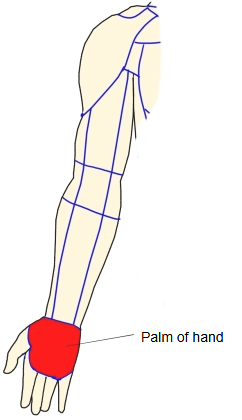
The palm of the hand
It lies between the wrist and the bases of the fingers; on the back of the hand lies the dorsum of hand, and distally the palm continues into the palmar regions of the fingers. Its two fleshy mounds are the thenar eminence at the base of the thumb, formed by the thenar muscles, and the smaller hypothenar eminence on the little-finger side, formed by the hypothenar muscles. Under the thick, hairless skin lies the tough palmar aponeurosis. Deeper, the flexor tendons, the superficial palmar arch and branches of the median nerve and ulnar nerve run towards the fingers. At the wrist end, the flexor tendons and the median nerve enter the palm through the carpal tunnel, under the flexor retinaculum.
 Palm of hand
 Regions of the upper limb (anterior)
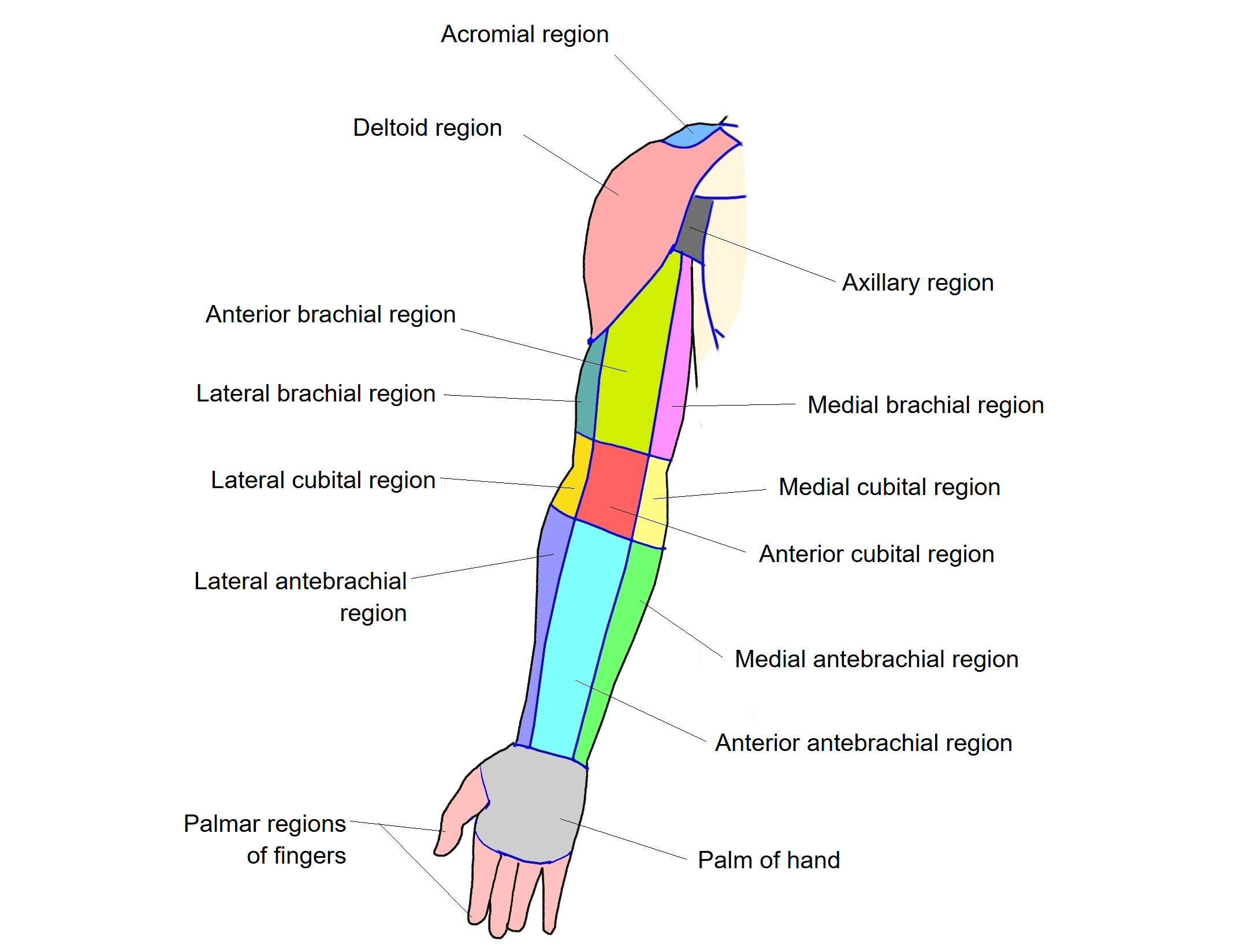
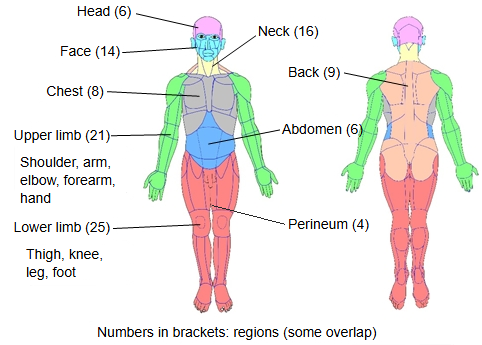
On this site the body is divided into nine parts: the head, face and neck (the head and neck), the chest, abdomen and back (the trunk), the perineum, and the upper and lower limbs. Each part is divided further into smaller regions: the upper limb has 21 regions, the lower limb 25, the back 9 (including the gluteal region) and the perineum 4.
- Head and neck : 1. head 2. face 3. neck
- Trunk : 1. chest 2. abdomen 3. back (9 regions, including the gluteal region)
- Perineum : 1. perineal region 2. anal region 3. urogenital region 4. pudendal region
- Limbs
- Upper limb : 1. shoulder 2. arm 3. elbow 4. forearm 5. hand (21 regions)
- Lower limb : 1. thigh 2. knee 3. leg 4. foot (25 regions)
Related terms
- Dorsum of hand
- Intrinsic muscles of hand
- Hypothenar muscles
- Bones of upper limb
- Thenar muscles
- Palmar aponeurosis
- Carpal tunnel
- Flexor retinaculum (hand)
- Superficial palmar arch
- Anterior region of elbow
- Medial antebrachial region
References and sources
- Further reading: Hand, Wikipedia.
- Federative International Programme for Anatomical Terminology (FIPAT). Terminologia Anatomica, 2nd ed. (TA2), 2019.