Posterior obturator tubercle (Latin: tuberculum obturatorium posterius)
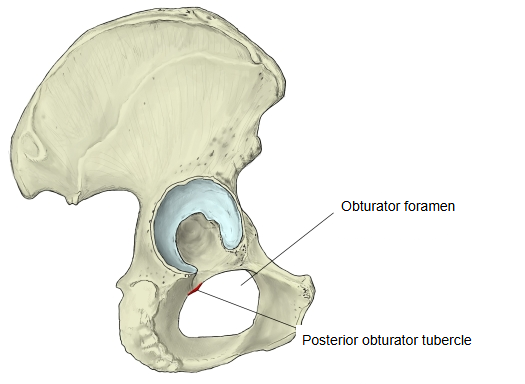
Some textbooks name this tubercle in their illustrations without describing it in detail. One description in the context of the ischium runs as follows.
The ischium forms the lower back part of the hip bone and surrounds the obturator foramen from behind and below. The thick, three-sided part that forms the lower back part of the acetabulum and lies below it is the body of the ischium; the thin, flattened bar that runs forwards, medially and upwards from it is the ramus of the ischium. The anterior border of the body is a sharp ridge that forms the back part of the upper margin and the posterior margin of the obturator foramen. A spine-like projection often seen on this anterior border, below the acetabular notch and near the place where the ischium fuses with the pubis, is the posterior obturator tubercle.
anatomyEXPERT describes it in a similar way:
A small bump on the anterior border of the ischial body (the posterior margin of the obturator foramen), just below the acetabular notch. The upper band of the obturator membrane is attached to it, and the obturator groove lies above this band.
· Together with the anterior obturator tubercle on the pubis, it marks the ends of the obturator groove; above the upper band of the obturator membrane lies the obturator canal for the obturator vessels and nerve. It is often, but not always, distinct, and its size varies.
Related terms
- Obturator foramen
- Obturator membrane
- Obturator groove
- Obturator canal
- Acetabular notch
- Ischium
- Hip bone
References and sources
- Further reading: Obturator foramen, Wikipedia.
- Further reading: Ischium, Wikipedia.
- Federative International Programme for Anatomical Terminology (FIPAT). Terminologia Anatomica, 2nd ed. (TA2), 2019.