Photoreceptor cell
Also called: visual cell; photoreceptor
· A photoreceptor cell is the sensory cell that turns light reaching the retina into a change of its membrane potential.
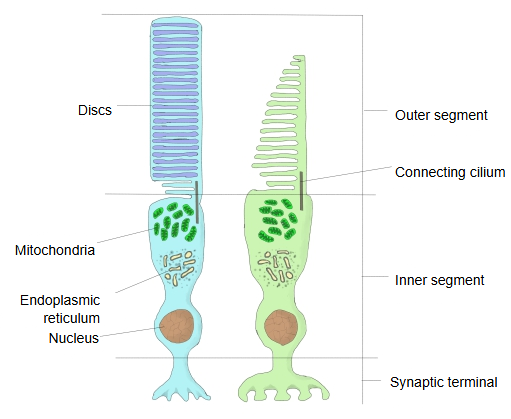
· Each photoreceptor has a process called the outer segment, a stack of membrane discs rich in the light-sensitive visual pigment (rhodopsin in rods, cone opsins in cones). It is joined by a connecting cilium to the inner segment, which is rich in mitochondria; then follow the cell body with the nucleus and the synaptic terminal.
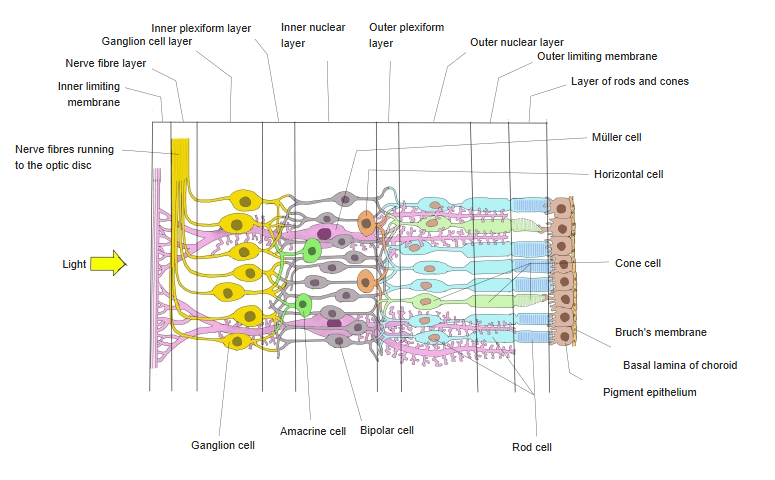
· Photoreceptors form the outermost layer of the neural retina (the layer of rods and cones), next to the pigment epithelium; seen from the inside of the eye they are the deepest cells, so light passes through the other retinal layers before reaching them. They are the first neurons of the visual pathway and pass their signal to bipolar cells and then to ganglion cells. A small group of ganglion cells is also light-sensitive; these help set the circadian rhythm and the pupillary reflex but are not counted as classic photoreceptors.
receptor
cells
- Rod cell : rod-shaped outer segment; the great majority of photoreceptors. Very sensitive, it serves light reception in dim light, without colour.
- Cone cell : cone-shaped outer segment; concentrated in the centre of the retina (macula and fovea). It works in bright light and gives sharp and colour vision.
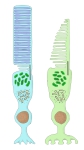 Photoreceptor cells (rod and cone)
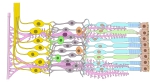 Structure of the retina
Reference websites
[Wikipedia]
· Photoreceptor cell, Wikipedia.
· Rod cell, Wikipedia.
[Websites with illustrations]
· Rods and cones (Wikimedia Commons)

· Retina (Kenhub)
Related terms
- Rod cell
- Outer segment of photoreceptor
- Inner segment of photoreceptor
- Layer of rods and cones
- Retinal pigment epithelium
- Retinal ganglion cell
- Optic part of retina
References and sources
- Further reading: Photoreceptor cell, Wikipedia.
- Federative International Programme for Anatomical Terminology (FIPAT). Terminologia Anatomica, 2nd ed. (TA2), 2019.