Plantar arch (Latin: arcus plantaris profundus)
Also called the deep plantar arch
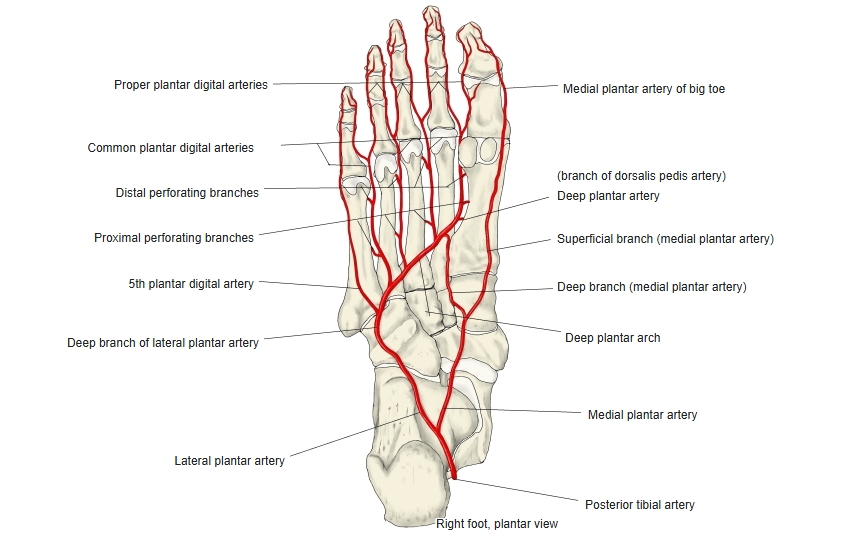
· It is an arterial arch in the sole formed by the union of a branch of the anterior tibial artery, which runs down the front of the leg, and a branch of the posterior tibial artery, which runs down the back of the leg.
· The arch lies deep to adductor hallucis, between this muscle and the interosseous muscles, and curves gently forwards (convex anteriorly). It runs from the base of the fifth metatarsal to the space between the first and second metatarsals.
· Many texts call it the deep plantar arch. Some also name a superficial plantar arch, comparable to the superficial palmar arch of the hand.
In humans, who walk upright, the superficial plantar arch is very small and of little practical importance. Some authors hold that, if the finest vessels are counted, it is always present and gives off the common plantar digital arteries; sources differ, and in everyday use "plantar arch" means the deep arch.
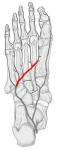 Plantar arch
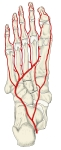 Arteries of the sole
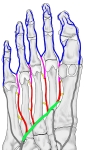 Branches of the arch
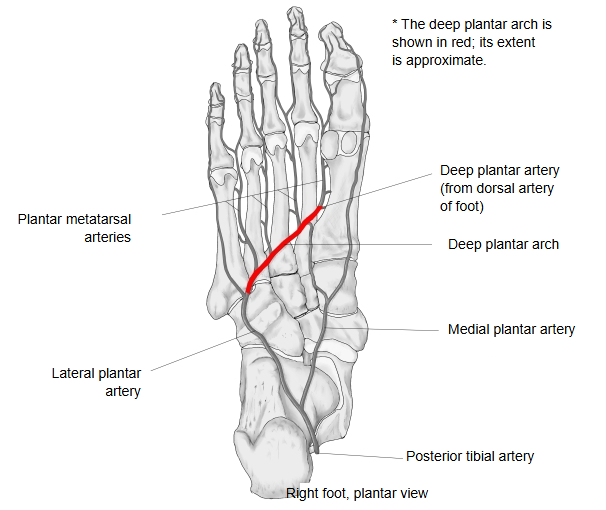
arch
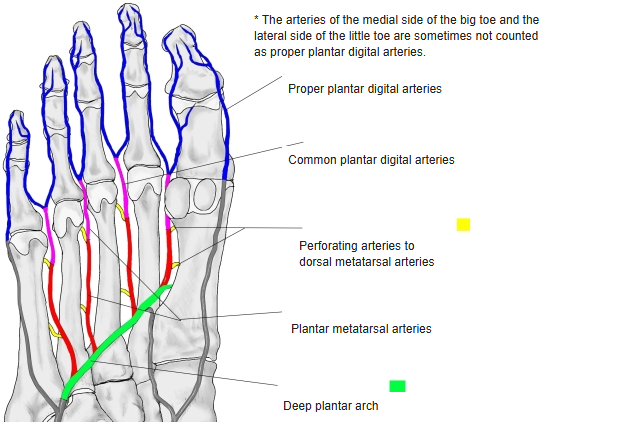
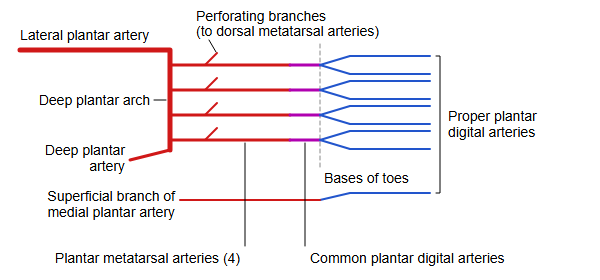
- Plantar metatarsal arteries : four arteries that run forwards in the intermetatarsal spaces.
- Perforating branches : a proximal and a distal one on each; they pass up to the dorsal metatarsal arteries.
- Proper plantar digital arteries : two from each plantar metatarsal artery, plus two more (medial side of the big toe, lateral side of the little toe); they run along both sides of each toe.
- Common plantar digital arteries : the short part from the distal perforating branch to the division into two proper plantar digital arteries.
Reference websites
[Wikipedia]
· Plantar arch, Wikipedia.
Related terms
- Lateral plantar artery
- Deep plantar artery
- Plantar metatarsal arteries
- Perforating branches of plantar metatarsal arteries
- Common plantar digital arteries
- Proper plantar digital arteries
- Deep palmar arch
References and sources
- Further reading: Plantar arch, Wikipedia.
- Federative International Programme for Anatomical Terminology (FIPAT). Terminologia Anatomica, 2nd ed. (TA2), 2019.