Latin: musculus adductor hallucis
Overview
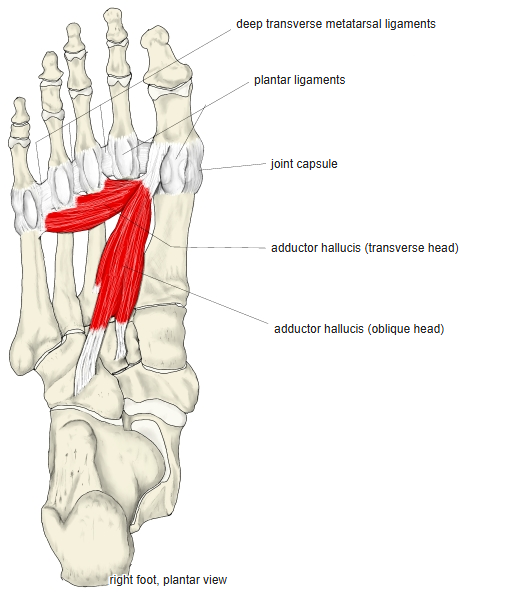
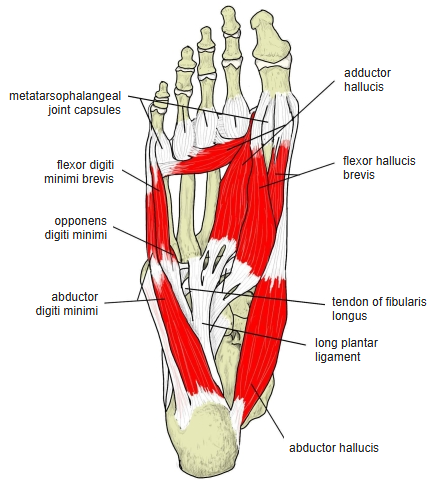
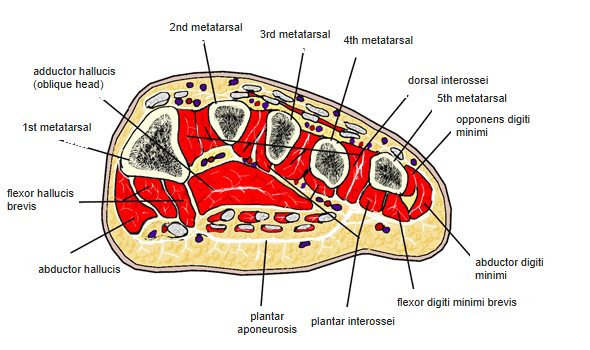
- Two heads: a large, thick oblique head and a narrow, flat transverse head.
- Almost completely covered by the tendons of the long and short toe flexors.
- The oblique head helps the flexor hallucis brevis flex the big toe; the transverse head draws the metatarsals together and helps keep the transverse arch.
Position in the classification
Lower Limb › Foot › Sole of foot › Muscles of the big toe
- Abductor hallucis
- Flexor hallucis brevis
- Adductor hallucis
Illustrations
Origin / insertion
- Origin (sources differ):
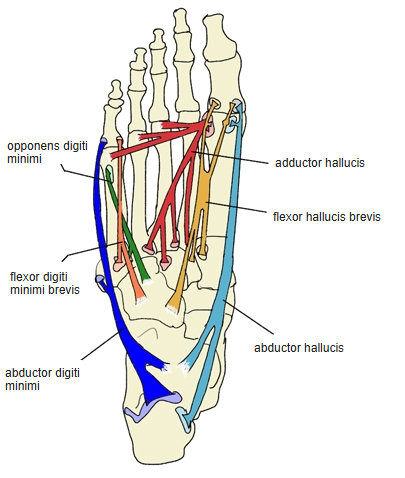
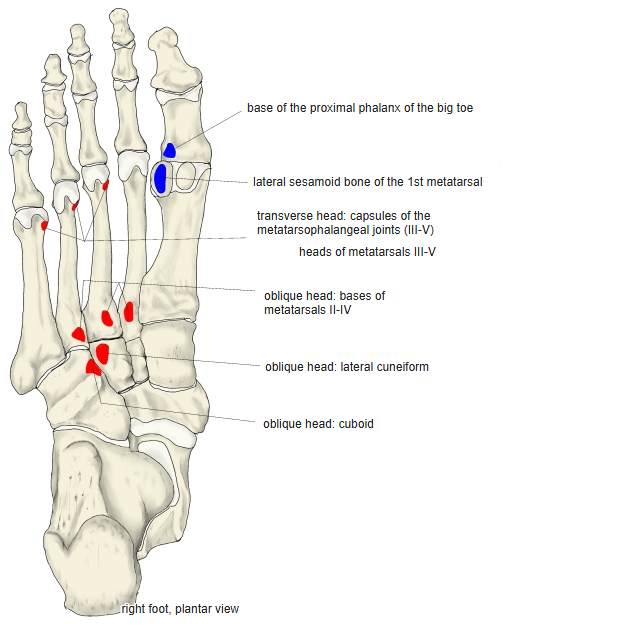
- Oblique head: cuboid, lateral cuneiform, long plantar ligament, bases of metatarsals 2–4
- Transverse head: capsules of the MTP joints and heads of metatarsals 3–5
- Insertion: lateral side of the base of the proximal phalanx of the big toe, with the lateral sesamoid bone
Action
- Adducts the big toe (moves it towards the other toes); the oblique head also helps flex it
Innervation
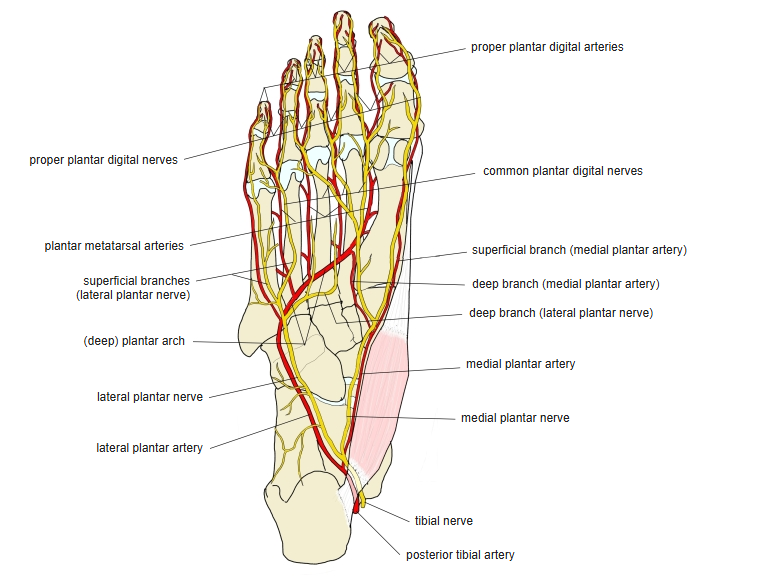
- Lateral plantar nerve (S2–S3; deep branch)
Blood supply
- Lateral plantar artery, perforating arteries from the dorsalis pedis artery
Anatomical variations
- A tendon may go from the oblique head to the 2nd toe; the transverse head may be partly or wholly absent; some oblique bundles may end on the 1st metatarsal ("opponens hallucis") (Rauber-Kopsch)
Related terms
- Flexor hallucis brevis
- Abductor hallucis
- Adductor pollicis
- Sesamoid bone
- Lateral plantar nerve
References and sources
- Further reading: Adductor hallucis muscle, Wikipedia.