Long crus of incus (Latin: crus longum incudis)
Also called the long limb or long process of the incus.
The long crus of the incus is one of the parts of the incus: it runs almost vertically downwards from the body of the incus.
Incus: one of the auditory ossicles in the tympanic cavityIt runs parallel to and behind the medial side of the handle of the malleus
The lower end of the long crus is rounded and enlarged as the lenticular process, which articulates with the head of the stapes.
- Body of incus : lies in the epitympanic recess of the tympanic cavity and has the articular surface for the malleus.
- Crura
- Short crus : runs almost horizontally backwards from the body and rests in the fossa of incus.
- Long crus : runs vertically downwards from the body, roughly parallel to the handle of the malleus.
- Lenticular process : the rounded enlargement at the tip of the long crus that articulates with the head of the stapes.
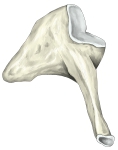 Left incus (medial view)
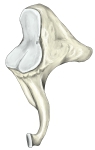 Left incus (anterior view)
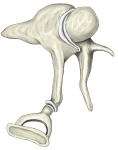 Left auditory ossicles (medial view)
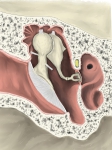 Right tympanic cavity (anterior view)
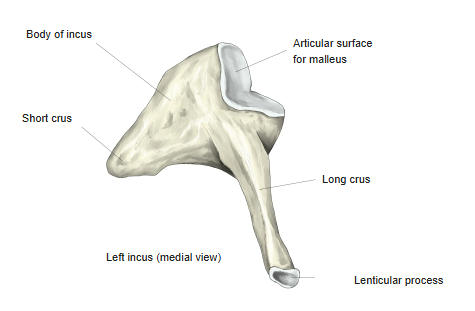
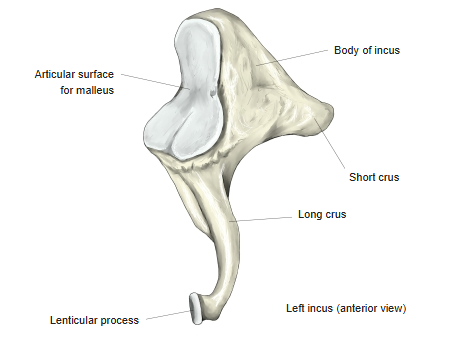
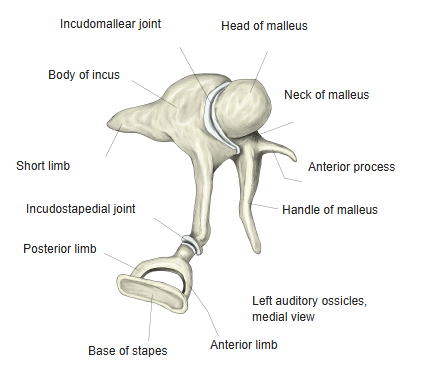
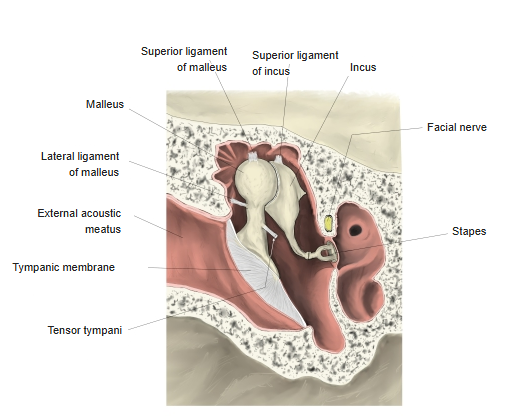
· The long crus is a slender process that lies behind and medial to the handle of the malleus. Its lower end bends medially before ending in the lenticular process, so that the incus links the malleus to the stapes at the incudostapedial joint.
· The tip of the long crus has a poor blood supply and is the part of the ossicular chain most often eroded in chronic middle-ear disease.
Reference websites
[Wikipedia]
· Incus, Wikipedia.
[Websites with illustrations]
· Incus: body, short and long limbs (Kenhub)
· The middle ear: ossicles and their joints (TeachMeAnatomy)
Related terms
- Incus
- Body of incus
- Lenticular process
- Head of stapes
- Fossa of incus
- Handle of malleus
- Auditory ossicles
References and sources
- Further reading: Incus, Wikipedia.
- Federative International Programme for Anatomical Terminology (FIPAT). Terminologia Anatomica, 2nd ed. (TA2), 2019.