Sternocostal joints (Latin: articulationes sternocostales)
Also called Costosternal joints
What are the sternocostal joints?
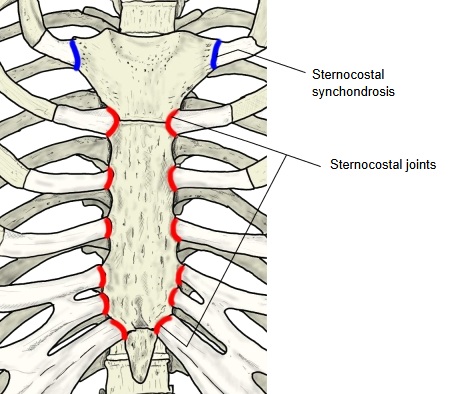
The sternocostal joints are the joints between the sternal ends of the costal cartilages and the costal notches of the sternum.
However, the 1st costal cartilage is joined directly to the 1st costal notch (there is no joint cavity); this union is called the sternocostal synchondrosis.
Three ligaments are usually listed for these joints: the radiate sternocostal ligaments, the intra-articular sternocostal ligament and the costoxiphoid ligaments.
More about the joints
The sternocostal joints join the costal cartilages of the upper seven pairs of ribs (the true ribs) to the costal notches of the sternum. The 2nd to 7th are plane joints. The 1st costal cartilage is united directly with the sternum and forms a synchondrosis rather than a synovial joint. The joint cavity is originally divided in two by the intra-articular sternocostal ligament, but this arrangement persists regularly only in the joint of the 2nd costal cartilage, which meets the junction of the manubrium and the body of the sternum. In the joints below it, the cavity tends to disappear with age.
The joints are strengthened by the following ligaments:
- Radiate sternocostal ligaments: bands on the front and back of each joint that spread out like a fan from the sternal end of the costal cartilage to the sternum. On the front, their fibres interlace with those of the opposite side and with the periosteum of the sternum to form a membrane over the bone (the sternal membrane).
- Intra-articular sternocostal ligament: divides the joint cavity into two parts (regularly only at the 2nd costal cartilage).
- Costoxiphoid ligaments: small flat bands joining the 7th costal cartilage to the xiphoid process.