Tarsometatarsal joints (Latin: articulationes tarsometatarsales)
Also called Lisfranc's joint
What are the tarsometatarsal joints?
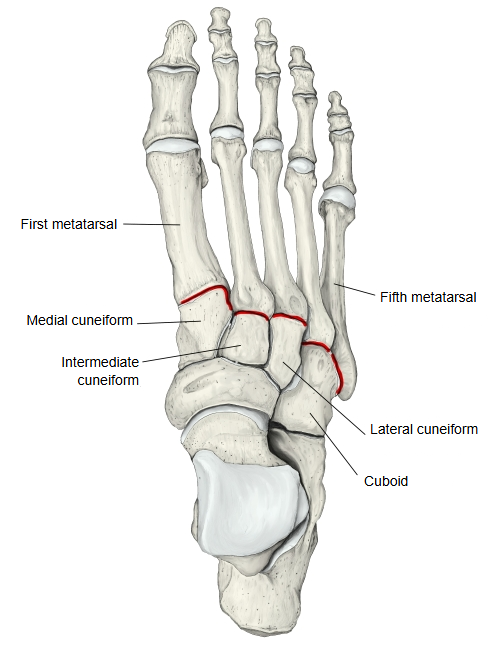
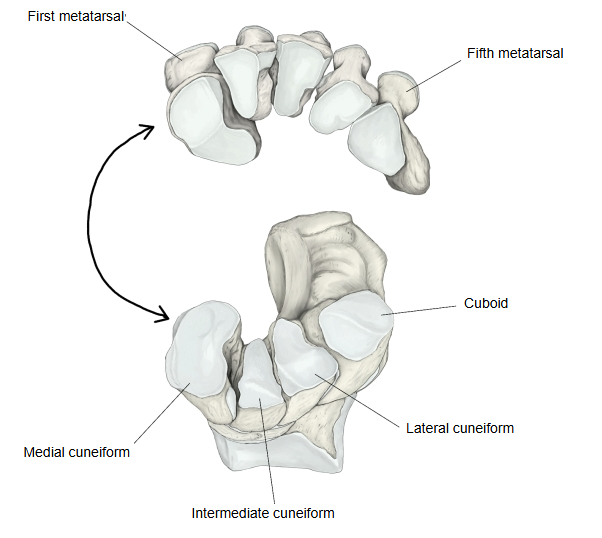
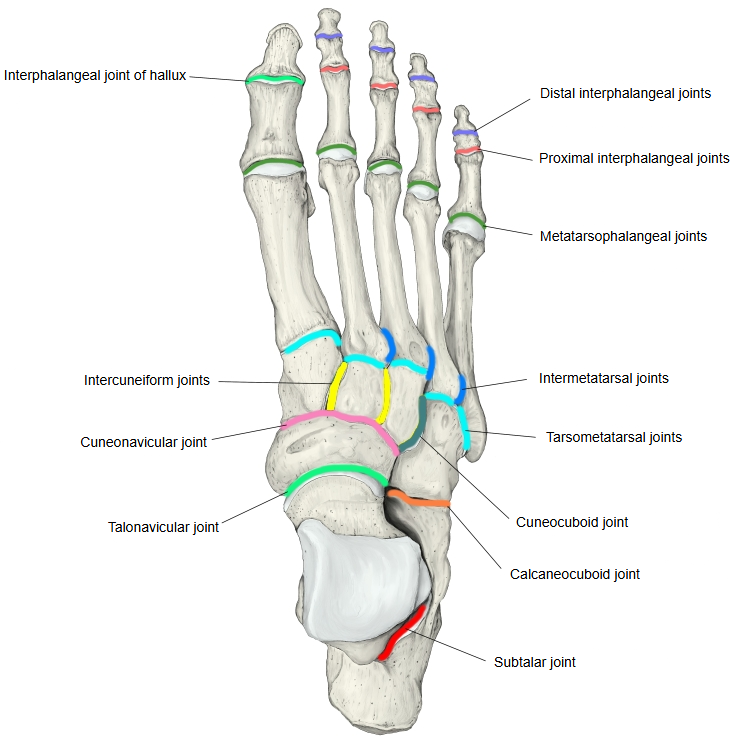
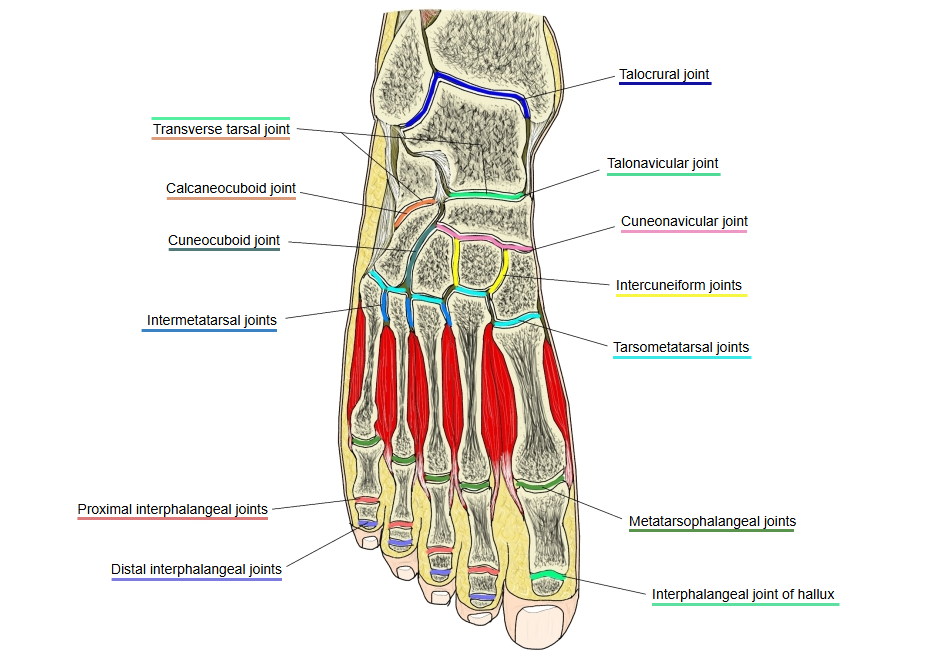
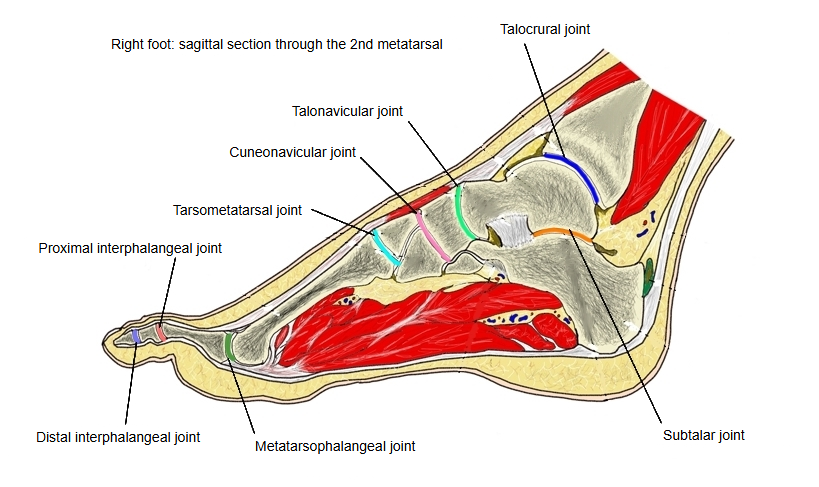
Joints of the foot formed between the bases of the five metatarsal bones and the four distal tarsal bones (the three cuneiforms and the cuboid).
- Joints of the tarsus (2 kinds)
- Joints of the metatarsus (2 kinds)
- Intermetatarsal joints
- Tarsometatarsal joints
- Joints of the toes (2 kinds)
| No | Name | Bones | Type | Other |
|---|---|---|---|---|
| 1 | 1st tarsometatarsal joint | 1st metatarsal ⇔ medial cuneiform | Plane joint, often saddle-shaped (saddle joint) | Has its own joint capsule |
| 2 | 2nd tarsometatarsal joint | 2nd metatarsal ⇔ intermediate cuneiform | Plane joint (moves very little: amphiarthrosis) | 2nd and 3rd joints share one capsule and joint cavity |
| 3 | 3rd tarsometatarsal joint | 3rd metatarsal ⇔ lateral cuneiform | ||
| 4 | 4th tarsometatarsal joint | 4th metatarsal ⇔ cuboid | 4th and 5th joints share one capsule and joint cavity | |
| 5 | 5th tarsometatarsal joint | 5th metatarsal ⇔ cuboid |
Note: "Lisfranc's joint" (Lisfranc joint) is a collective name for the tarsometatarsal joints.
The main facts about the tarsometatarsal joints are:
- They are plane joints.
- The joint between the medial cuneiform and the 1st metatarsal has a separate joint capsule, but it moves very little. Its articular surfaces are often saddle-shaped.
- The other joints are enclosed in common capsules. An interosseous ligament running from the lateral cuneiform to the 4th metatarsal divides them into a medial and a lateral part.
- Usually three separate joint cavities are found: (1) between the 1st metatarsal and the medial cuneiform; (2) a common cavity for the 2nd metatarsal with the intermediate cuneiform and the 3rd metatarsal with the lateral cuneiform; (3) a common cavity for the 4th and 5th metatarsals with the cuboid. Cavities (2) and (3) are sometimes joined.
- The middle cavity (2) almost always communicates with the cuneonavicular joint and with the intermetatarsal joints between the 2nd, 3rd and 4th metatarsals; the other cavities are closed.
The intermediate cuneiform is shorter than the cuneiforms on either side of it, so its joint with the 2nd metatarsal is set back proximally. The base of the 2nd metatarsal is therefore locked in a recess between the medial and lateral cuneiforms, and the joint line as a whole does not run straight across the foot but zigzags. The joint line is named after the French surgeon Jacques Lisfranc (1790–1847), who described it in 1815 as a site for amputation of the foot.
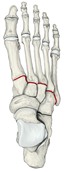 Right foot
(dorsal view)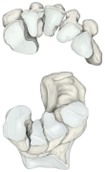 Tarsometatarsal joints
(articular surfaces)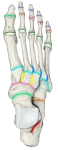 Right foot
(dorsal view)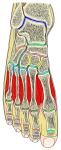 Right foot
(section) Right foot
(sagittal section)
Bones
(distal tarsal bones = medial, intermediate and lateral cuneiforms and the cuboid)
Type
Ligaments
| Ligament | |
|---|---|
| 1 | Dorsal tarsometatarsal ligaments |
| 2 | Plantar tarsometatarsal ligaments |
| 3 | Interosseous cuneometatarsal ligaments |