Uncovertebral joints (Latin: articulationes uncovertebrales)
Also called Joints of Luschka
What are the uncovertebral joints?
(Uncinate process = a lip projecting upwards from the posterolateral margin of the upper surface of the vertebral body.)
- Whether they are only clefts or true joints with a joint capsule has long been debated.
- They are small: each measures about 2 × 4 mm to 3 × 6 mm.
Illustrations
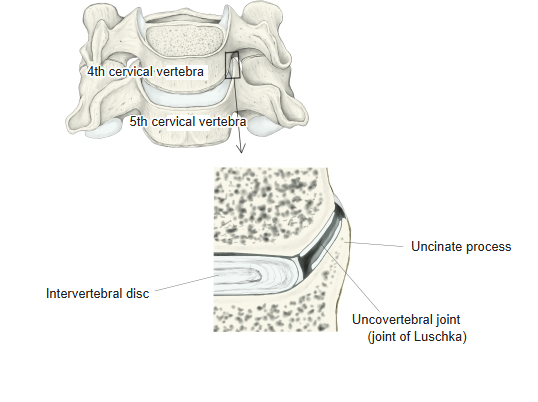
More about the joints
On the upper surface of the bodies of the 3rd to 7th cervical vertebrae, the posterolateral margins rise upwards as the uncinate processes (also called Luschka's processes). Because each process touches the body of the vertebra above, the contact is called Luschka's joint, or the uncovertebral joint. Whether it is only a cleft or a true joint with a capsule is debated. The region forms the front wall of the intervertebral foramen, so bony spurs (osteophytes) growing here narrow the foramen and can damage the spinal nerve. The joint is named after the German anatomist Hubert von Luschka (1820–1875).
Described as small synovial joints, they lie between the bodies of the lower five cervical vertebrae. Each lies in front of and medial to the spinal nerve root, and behind and medial to the vertebral artery and vein and the sympathetic nerves that run through the foramina of the transverse processes. Together with the intervertebral disc and the vertebral bodies, they form the front wall of the intervertebral foramen. The convex, cartilage-covered uncinate process of the lower vertebra meets a matching concave, cartilage-covered area on the underside of the vertebra above (sometimes called the uncus).
The joints are hardly present at birth and develop with age. As the intervertebral discs degenerate, the uncinate processes come closer to the vertebral body above, and degenerative joint changes follow.
- Articular surfaces: the uncinate process below and the matching area (uncus) of the vertebral body above.
- Movements: they allow flexion and extension of the cervical spine and limit lateral flexion.
- Function: they are thought to reinforce the intervertebral disc at the back and sides, helping to protect against disc herniation; they prevent the vertebral bodies from sliding backwards on each other; and they help to stabilise and guide the movements of the cervical spine.