Vertebral body (Latin: corpus vertebrae)
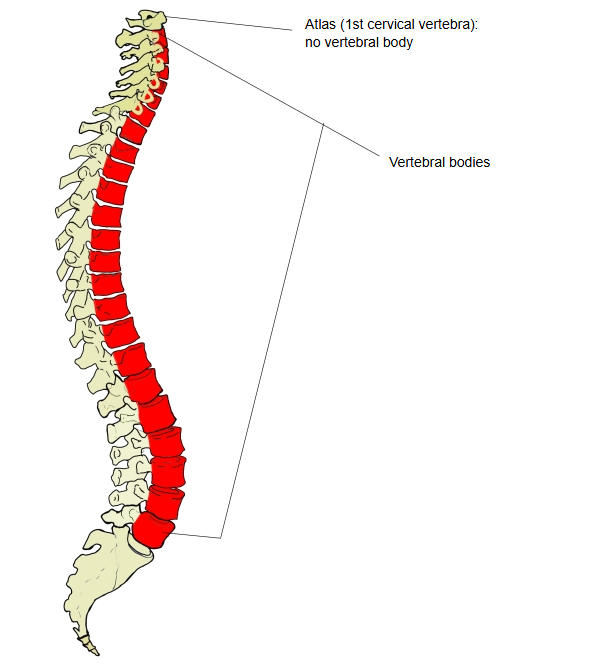
· The atlas (first cervical vertebra) has no vertebral body.
· Its upper and lower ends are flat surfaces (the intervertebral surfaces), covered by hyaline cartilage inside a raised rim, the anular epiphysis.
· Each body is joined to the bodies above and below by an intervertebral disc ⇒ the joints between the vertebral bodies.
· Its back forms the front wall of the vertebral foramen, with a broad, shallow vertical groove; the pedicles join it to the vertebral arch behind.
· Seen from the side, it is slightly waisted in the middle.
Its features differ between the kinds of vertebrae; the bodies get larger from the neck down to the lower back, as the load they carry increases.
| 1 | Cervical vertebrae | · The atlas (first cervical vertebra) has no vertebral body; its body is regarded as having joined the axis as the dens. · The bodies get larger further down, but are small compared with thoracic and lumbar bodies. They are wider from side to side than from front to back, and the upper surface is turned up at each side as the uncinate process. |
| 2 | Thoracic vertebrae | · Larger than cervical bodies but smaller than lumbar ones, and tending to get larger further down; roughly heart-shaped from above. · On the sides of the body are small joint surfaces for the heads of the ribs, the costal facets. |
| 3 | Lumbar vertebrae | · The largest of all vertebral bodies, broadly kidney-shaped from above, with no costal facets. · They get wider further down, but are thickest at about the third or fourth lumbar vertebra. |
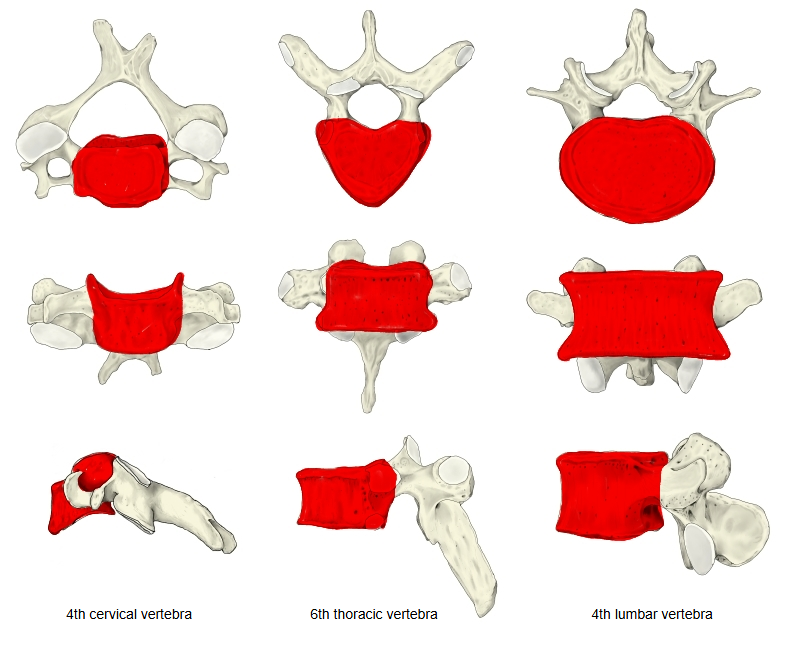 Vertebral bodies of C4, T6 and L4
 Vertebral column (lateral)
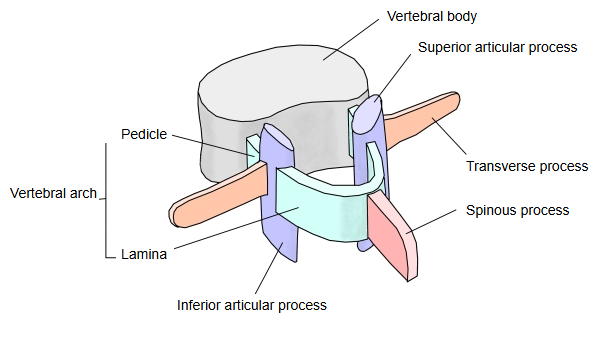
The basic parts of a vertebra are as follows.
structure
of a
vertebra
- Vertebral body : the cylindrical front part, joined to the vertebrae above and below by intervertebral discs.
- Vertebral arch
- Processes
- Spinous process : the long process pointing backwards.
- Transverse process : the processes to the left and right sides (in the lumbar vertebrae: the costal process).
- Superior and inferior articular processes : processes going up and down from the arch.
The vertebral body is a short cylinder forming the front of the vertebra, with flat upper and lower ends. These ends are slightly wider than the middle, so that seen from the side the body is slightly waisted. Its back forms the front wall of the vertebral foramen, with a broad, shallow vertical groove. The upper and lower surfaces are covered by a thin plate of hyaline cartilage, to which the intervertebral disc is firmly attached. The edge of this cartilage ossifies to form a ring, open behind, the anular epiphysis (epiphyseal ring); with age this ossification goes further, and the rims of the upper and lower surfaces come to project sideways.
Inside, the vertebral body is spongy (cancellous) bone filled with red marrow, inside a thin shell of compact bone. The pedicles project backwards from each side of the body and join the laminae to form the vertebral arch. Because the vertebral bodies bear most of the load, they are the usual site of compression fractures, especially in osteoporosis.
Reference websites
[Wikipedia]
· Vertebra, Wikipedia.
· Intervertebral disc, Wikipedia.
[Websites with illustrations]
· The vertebral column (TeachMeAnatomy)
· A typical thoracic vertebra from above (Gray's Anatomy) (Wikimedia Commons)

· A lumbar vertebra from above and behind (Gray's Anatomy) (Wikimedia Commons)

Where it is found
Related terms
- Vertebral column
- Spinous process
- Costal facets
- Uncinate process
- Dens
- Cervical vertebrae
- Thoracic vertebrae
- Lumbar vertebrae
References and sources
- Further reading: Vertebra, Wikipedia.
- Further reading: Intervertebral disc, Wikipedia.
- Federative International Programme for Anatomical Terminology (FIPAT). Terminologia Anatomica, 2nd ed. (TA2), 2019.