Oleic acid
Overview
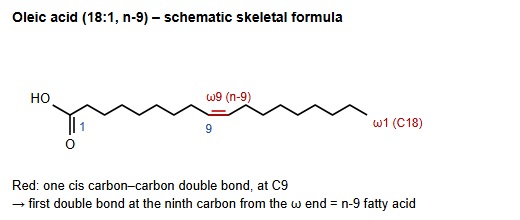
It has a straight chain of 18 carbon atoms with one cis double bond at the ninth carbon counted from the ω end (18:1 n-9). Pure oleic acid is a pale yellow, oily liquid at room temperature with a lard-like odour, and it does not dissolve in water. With only one double bond it is oxidised less easily than the polyunsaturated fatty acids, so oils rich in it keep well.
acids
- Saturated fatty acids : no carbon–carbon double or triple bonds; abundant in animal fats.
- Unsaturated fatty acids : one or more carbon–carbon double bonds.
- Monounsaturated : one double bond; typical example oleic acid.
- Polyunsaturated : two or more double bonds.
- n-3 fatty acids : alpha-linolenic acid●, EPA, DHA and others.
- n-6 fatty acids : linoleic acid●, gamma-linolenic acid, arachidonic acid and others.
Oleic acid is the main fatty acid of olive oil and is also plentiful in other vegetable oils, such as rapeseed oil, and in animal fats. In the body it is found mainly in neutral fat (triglyceride) of adipose tissue and in the phospholipids of cell membranes.
The body can make oleic acid from stearic acid, a saturated fatty acid, so it is not an essential fatty acid.
Reference websites
[Wikipedia]
· Oleic acid, Wikipedia.
Related terms
References and sources
- Further reading: Oleic acid, Wikipedia.
- Federative International Programme for Anatomical Terminology (FIPAT). Terminologia Anatomica, 2nd ed. (TA2), 2019.