Neutral fat
triglyceride
Nutritional aspects
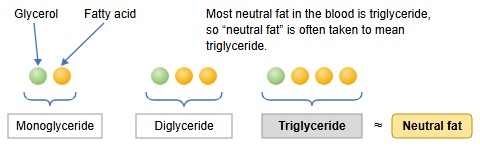
· Because the acidic fatty acids are bound to glycerol, the molecule as a whole is neutral; hence the name "neutral fat". Neutral fats that are solid at room temperature are usually called fats, and those that are liquid are called oils.
major
nutrients
- Protein : large molecules made of many amino acids; the material of muscle, bone and other tissues.
- Carbohydrate : sugars (including starch) and dietary fibre; an important source of energy.
- Lipids (= fat) : provide more than twice as much energy per gram as the other nutrients; used mainly as a source of energy.
[Neutral fat in food]
Neutral fat in food can be divided into two groups.
Neutral fat is one of the lipids (fats) of the three major nutrients. It is contained in the food we eat and is also stored in our body.
Anatomical aspects
in the
body
- Neutral fat : ≈ triglyceride; stored in fat cells as a reserve of energy.
- Fatty acids : stored mainly as part of neutral fat in adipose tissue; used as a source of energy, especially by muscle.
- Cholesterol : a component of the cell membrane; also the raw material of some hormones and of bile acids.
- Phospholipids : the main building units of the cell membrane.
[Neutral fat in our body]
In our body, neutral fat is found in the blood and in fat cells.
· 1. In the blood: carried around the body in the blood stream, packed in lipoproteins.
· 2. In fat cells: stored in fat cells as body fat. When needed, it is split into fatty acids and glycerol and used.
[Synthesis of neutral fat]
In the body, neutral fat is made in two ways.
① From the lipids in food
· In the duodenum, bile emulsifies the fat in food (mostly neutral fat) into small droplets.
· The digestive enzyme lipase of the pancreatic juice splits the neutral fat mainly into fatty acids and monoglycerides, which are absorbed in the small intestine.
· In the intestinal epithelial cells they are made into neutral fat again and sent into the body; part of it is stored in the liver and in fat cells.
② From sugars (carbohydrate)
Absorbed sugars (carbohydrate) are used first as energy; what is not used is changed into neutral fat in the liver and in fat cells. Sugars and lipids are both compounds of carbon, hydrogen and oxygen.
| Element | Sugars, lipids | Protein |
|---|---|---|
| Carbon (C) | Yes | Yes |
| Hydrogen (H) | Yes | Yes |
| Oxygen (O) | Yes | Yes |
| Nitrogen (N) | No | Yes |
[Main functions of neutral fat]
· 1. Source of energy: during exercise glycogen is used first; when it runs short, neutral fat becomes the main source of energy.
· 2. Keeping the body temperature: the fat under the skin works as insulation.
· 3. Cushioning: fat protects bones, internal organs and other tissues against shocks from outside.
· 4. Secretion: the fat cells that store neutral fat secrete physiologically active substances such as adiponectin and oestrogen (see white adipocyte).
Reference websites
[Wikipedia]
· Triglyceride, Wikipedia.
Related terms
References and sources
- Further reading: Triglyceride, Wikipedia.
- Federative International Programme for Anatomical Terminology (FIPAT). Terminologia Anatomica, 2nd ed. (TA2), 2019.