Latin: musculus levator ani
Overview
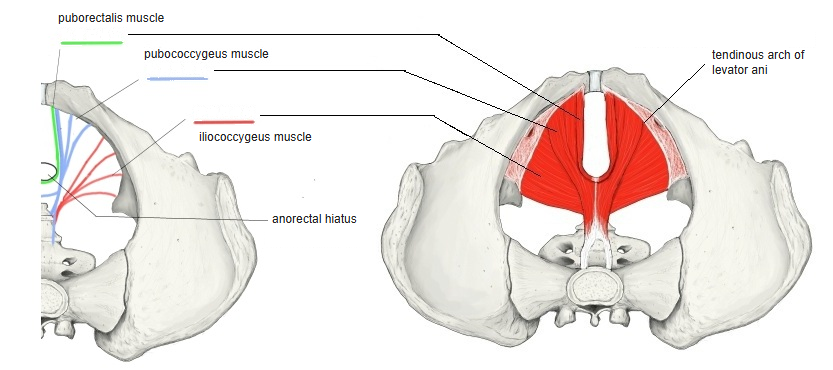
- One of the pelvic floor muscles: with the coccygeus it forms the pelvic diaphragm, which supports the pelvic organs. In the classification used here it is one of the three muscles of the anal group of the perineal muscles.
- It consists of three parts: the puborectalis, pubococcygeus and iliococcygeus.
- A thin, broad, funnel-shaped sheet of muscle that forms most of the floor of the pelvis and surrounds the structures passing through it, including the lower end of the rectum.
- In women its anterior fibres descend on the side of the vagina.
- See the pages of the individual parts for their attachments, actions, nerve supply and blood supply.
Position in the classification
Trunk › Pelvis › Levator ani
- Levator ani
Trunk › Perineum › Anal muscles
Illustrations
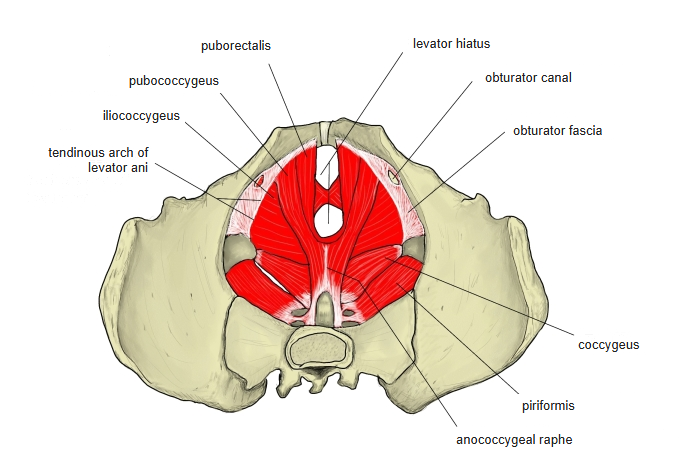
- Puborectalis: from the back of the pubis; its fibres meet those of the other side behind the lower end of the rectum (anorectal junction), forming a U-shaped sling.
- Pubococcygeus: from the back of the pubis and the anterior part of the obturator fascia to the coccyx and the anococcygeal raphe.
- Iliococcygeus: from the ischial spine and the posterior part of the tendinous arch of the levator ani to the coccyx and the anococcygeal raphe.
Related terms
- Puborectalis
- Pubococcygeus
- Iliococcygeus
- External anal sphincter
- Coccygeus
- Pelvic floor muscles
- Perineal muscles
References and sources
- Further reading: Levator ani, Wikipedia.
- Gray H. Anatomy of the Human Body, 20th ed. (1918), “6e. The Muscles and Fasciæ of the Pelvis”, Bartleby.com.