Latin: platysma
Overview
- A superficial muscle of the neck, placed with the sternocleidomastoid in this site's own group of "other" superficial neck muscles; a skin muscle, like the facial muscles.
- A thin, sheet-like muscle lying directly under the skin, in the superficial layer of the cervical fascia; it develops from the second pharyngeal (hyoid) arch.
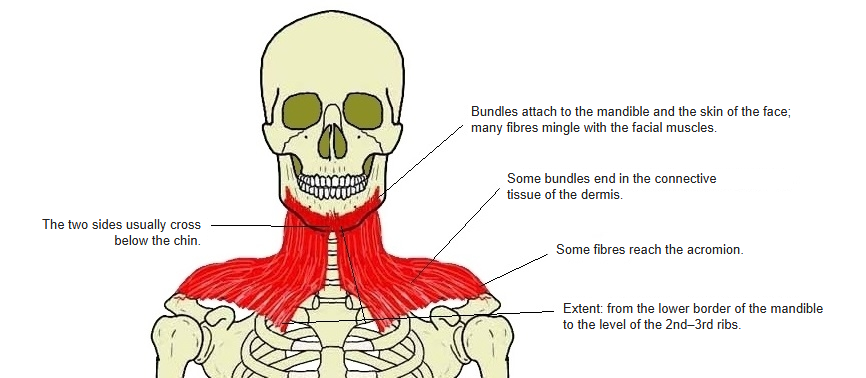
- Spreads from the lower face over the neck to the upper chest, from the border of the mandible to the level of the 2nd–3rd ribs, and further to the acromion.
- Firmly bound to the skin, loosely to the cervical fascia; it passes over the external jugular vein.
- The muscles of the two sides usually cross below the chin.
Position in the classification
Neck › Superficial muscles of the neck › Others
- Platysma
- Sternocleidomastoid
Origin / insertion
- Origin: the pectoral fascia along a line from the acromion to the front end of the 3rd rib (the fascia over the pectoralis major and deltoid); runs upward and medially
- Insertion: the mandible, the angle of the mouth, the masseteric fascia, the risorius, depressor anguli oris and depressor labii inferioris, and the skin of the lower face
- Many fibres mingle with the facial muscles; some bundles end in the connective tissue of the dermis.
Action
- Wrinkles the skin of the neck
- Tenses the cervical fascia and the masseteric fascia
- Pulls the angle of the mouth downward (helps to depress the mandible)
Innervation
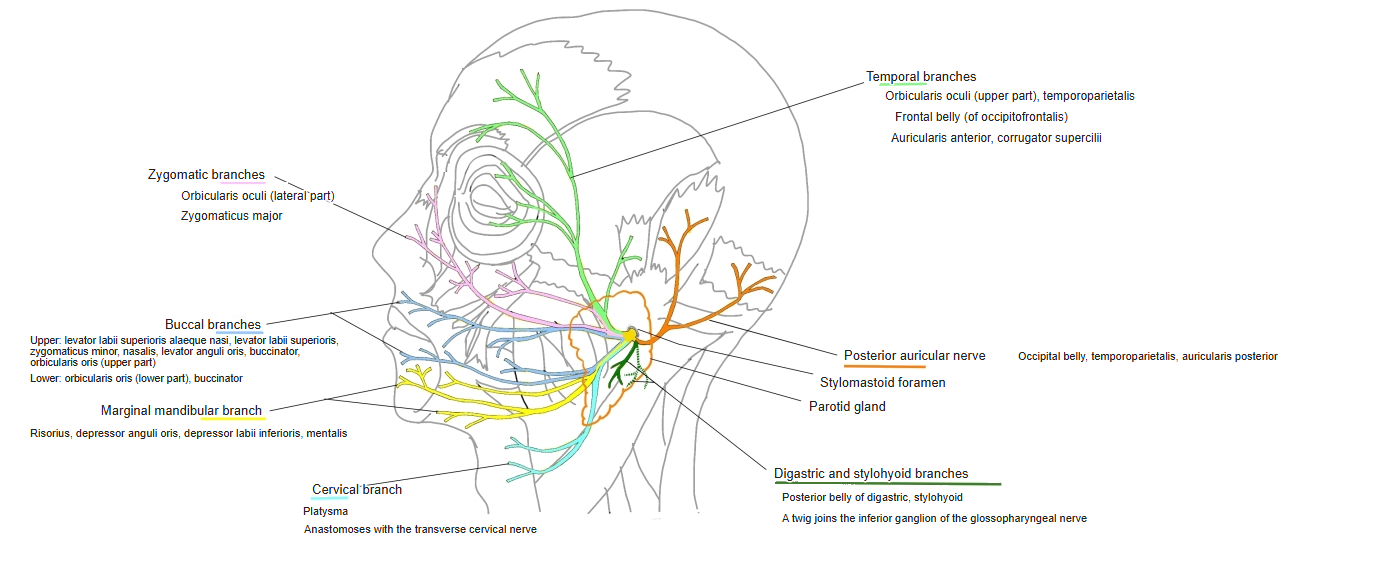
- Cervical branch of the facial nerve
Blood supply
- Submental artery (branch of the facial artery)
- Suprascapular artery (from the thyrocervical trunk)
From Kenhub.
Related terms
- Superficial muscles of the neck
- Sternocleidomastoid
- Facial muscles
- Depressor anguli oris
- External jugular vein
- Acromion
- Facial nerve
References and sources
- Further reading: Platysma muscle, Wikipedia.