Latin: musculus transversus linguae
Overview
- One of the four intrinsic muscles of the tongue (muscles lying entirely within the tongue).
- A strong muscle between the superior and inferior longitudinal muscles.
- Its fibres run transversely, from the lingual septum to the sides of the tongue.
- The fibres interlace with those of the vertical muscle and cross those of the opposite side.
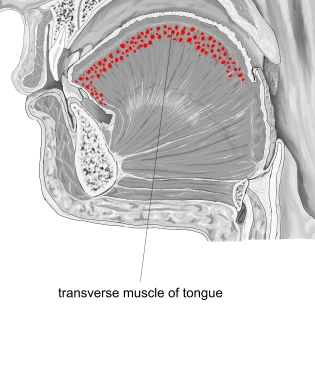
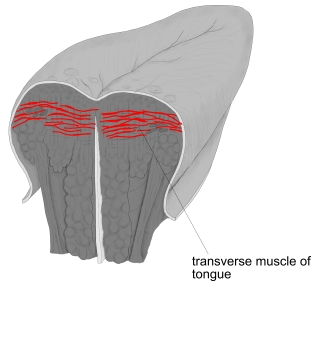
The red area in these two figures shows the transverse muscle only approximately.
Position in the classification
Head › Muscles of the tongue › Intrinsic muscles of the tongue
- Superior longitudinal muscle
- Inferior longitudinal muscle
- Transverse muscle of tongue
- Vertical muscle of tongue
Illustrations
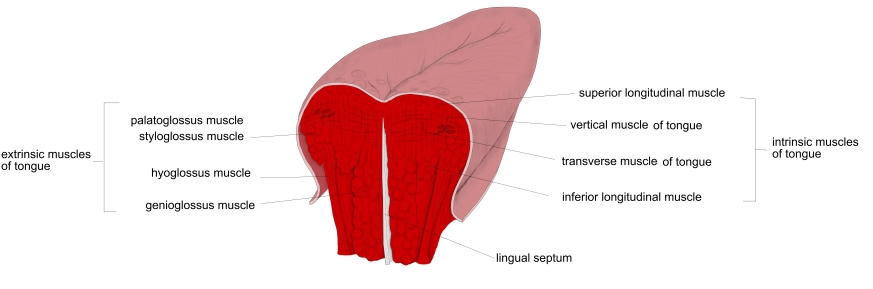
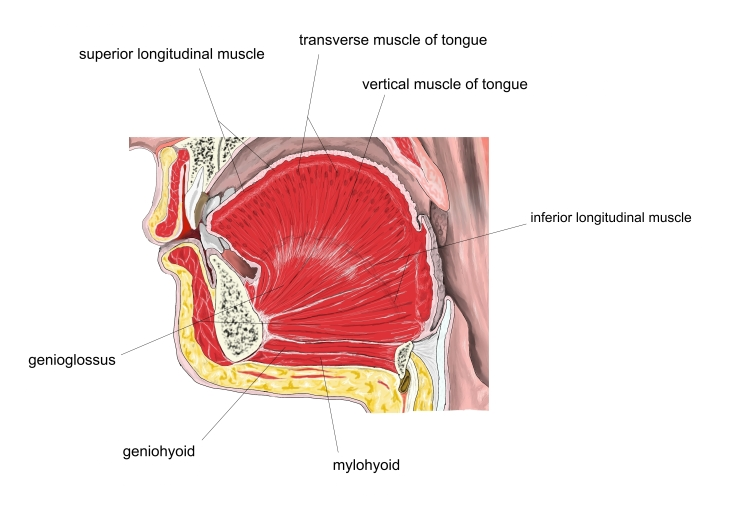
Origin / insertion
- Origin: lingual septum (most fibres)
- Insertion: mucosa (submucous tissue) of the lateral margins and dorsum of the tongue
Action
- Narrows and elongates the tongue
Innervation
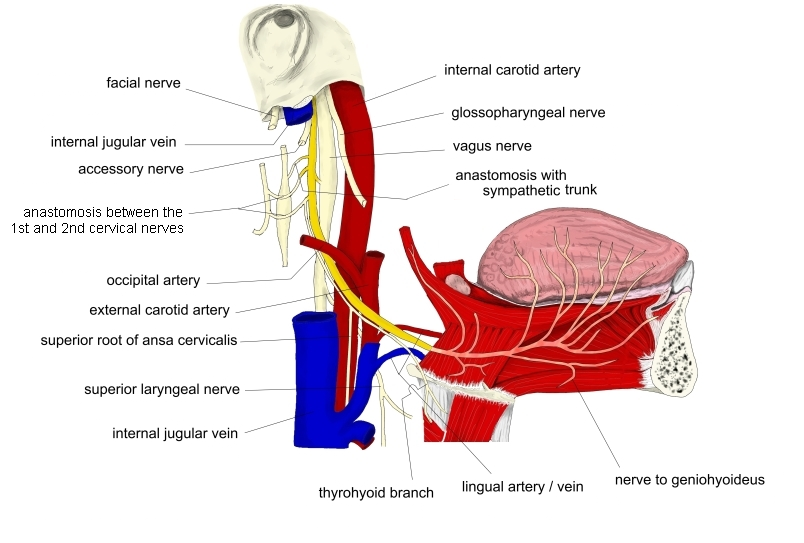
- Hypoglossal nerve (cranial nerve XII; motor)
Blood supply
- Artery: lingual artery (from the external carotid artery), the main supply of the tongue
- Veins: lingual veins, draining to the internal jugular vein
Compiled from standard anatomy references.
Related terms
- Intrinsic muscles of the tongue
- Extrinsic muscles of the tongue
- Superior longitudinal muscle
- Inferior longitudinal muscle
- Vertical muscle of tongue
- Lingual septum
- Hypoglossal nerve
References and sources
- Further reading: Transverse muscle of tongue, Wikipedia.
- Blood supply: Tongue, Wikipedia.