Conoid tubercle (Latin: tuberculum conoideum)
Also called: coracoid tuberosity
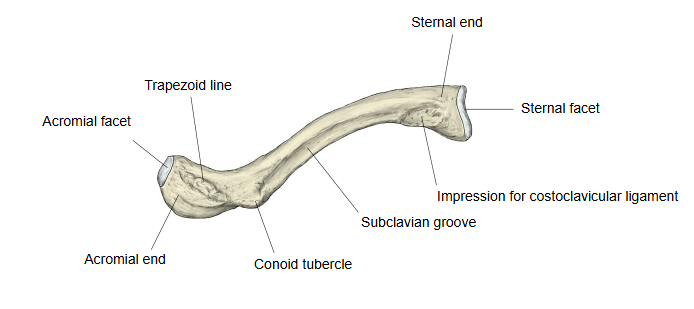
The conoid tubercle is a blunt projection on the under surface of the curved part of the acromial end of the clavicle; the conoid ligament is attached to it.
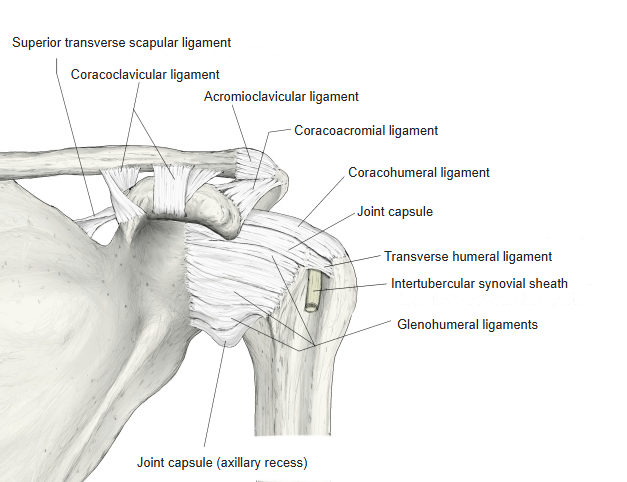
It lies on the inferior surface of the lateral third of the clavicle, close to its posterior border. The conoid ligament is the medial part of the coracoclavicular ligament, which rises from the base of the coracoid process of the scapula. The trapezoid line runs forwards and laterally from the tubercle; together they form the tuberosity for the coracoclavicular ligament. Its size varies; in some people it is large and prominent.
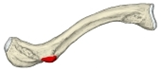 Conoid tubercle (inferior view)
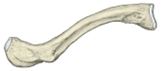 Right clavicle (inferior view)
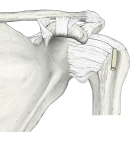 Left shoulder (anterior)
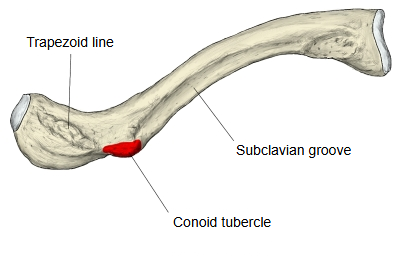
Reference websites
[Wikipedia]
· Conoid tubercle, Wikipedia.
· Coracoclavicular ligament, Wikipedia.
[Websites with illustrations]
· Left clavicle, inferior surface (Gray's Anatomy, fig. 201) (Wikimedia Commons)

· Clavicle (Kenhub)
· The clavicle (TeachMeAnatomy)
Where it is found
Related terms
- Trapezoid line
- Tuberosity for coracoclavicular ligament
- Coracoid process
- Acromial end of clavicle
- Shaft of clavicle
- Acromioclavicular joint
References and sources
- Further reading: Conoid tubercle, Wikipedia.
- Further reading: Coracoclavicular ligament, Wikipedia.
- Federative International Programme for Anatomical Terminology (FIPAT). Terminologia Anatomica, 2nd ed. (TA2), 2019.