Anatomical neck (Latin: collum anatomicum humeri)
Also called the anatomical neck of humerus
· The articular capsule of the shoulder joint is attached to it.
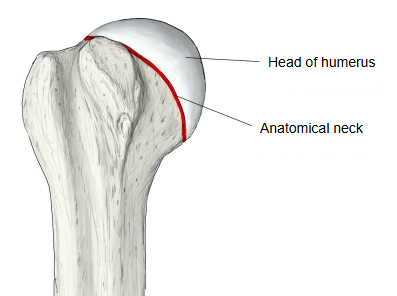
A shallow groove runs round the margin of the head of the humerus, so the bone is slightly narrowed there. This narrowing is the anatomical neck in the strict sense.
The anatomical neck is set obliquely, following the edge of the articular surface of the head, and forms an obtuse angle with the shaft. It is clearest below and medially; above, it is only a narrow groove separating the head from the greater tubercle and the lesser tubercle. It gives attachment to the fibrous capsule of the shoulder joint, except medially, where the capsule extends down onto the shaft for about 1 cm. Many small vascular foramina pierce it.
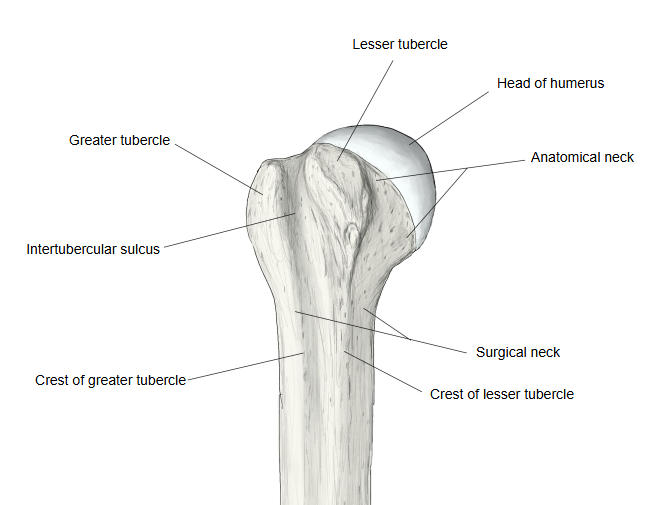
· Not to be confused with the surgical neck, the narrowing just below the tubercles. Fractures through the anatomical neck are uncommon, but they can cut off the blood supply to the head and lead to avascular necrosis.
Reference websites
[Wikipedia]
· Anatomical neck of humerus, Wikipedia.
· Humerus, Wikipedia.
[Websites with illustrations]
· Left humerus, anterior view (Gray's Anatomy, fig. 207) (Wikimedia Commons)

· The humerus: proximal, shaft and distal (TeachMeAnatomy)
Where it is found
Related terms
- Head of humerus
- Surgical neck
- Greater tubercle
- Lesser tubercle
- Upper end of humerus
- Glenohumeral joint
References and sources
- Further reading: Anatomical neck of humerus, Wikipedia.
- Federative International Programme for Anatomical Terminology (FIPAT). Terminologia Anatomica, 2nd ed. (TA2), 2019.