Dens (Latin: dens axis)
Also called the odontoid process or the dens of axis
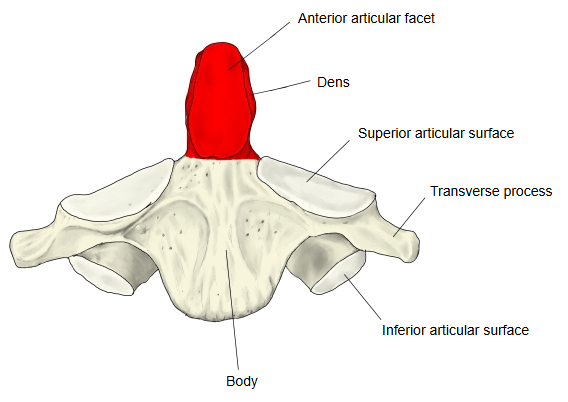
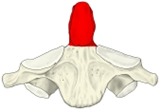 Axis (anterior)
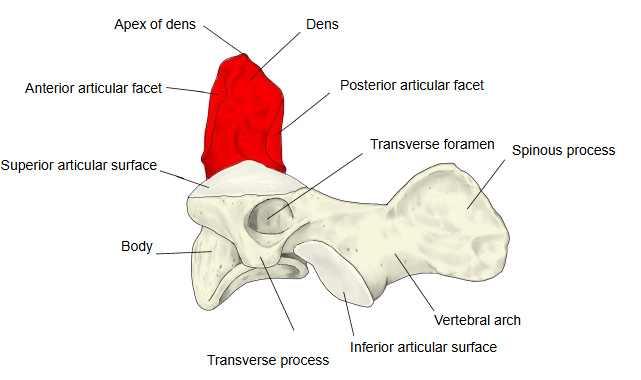
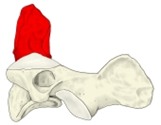 Axis (lateral)
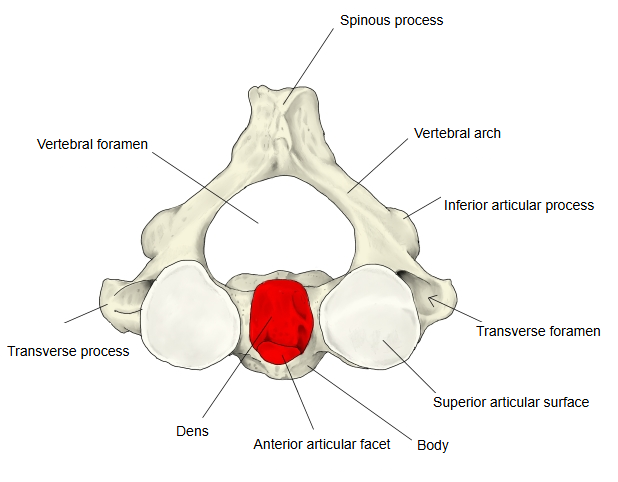
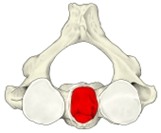 Axis (superior)
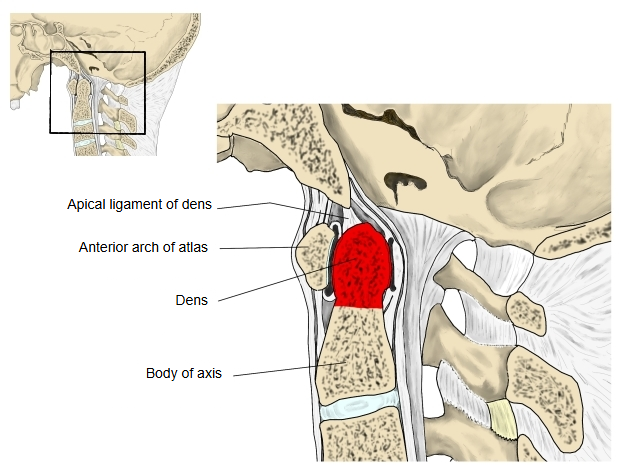
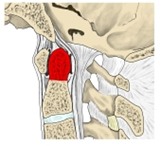 Upper neck (median section)
Reference websites
[Wikipedia]
· Axis (anatomy), Wikipedia.
· Atlanto-axial joint, Wikipedia.
[Websites with illustrations]
· Axis (C2) (Kenhub)
· The cervical spine (axis and dens) (TeachMeAnatomy)
The dens is slightly narrowed where it joins the body of the axis (its neck). The anterior articular facet meets the facet on the anterior arch of the atlas at the median atlanto-axial joint; the posterior articular facet is a groove for the transverse ligament of atlas, which holds the dens against the anterior arch. The apical ligament runs from the apex, and the alar ligaments from rough areas on its sides, to the margin of the foramen magnum; the strong alar ligaments limit rotation of the head, while the weak apical ligament is a fibrous remnant of the notochord. The bone of the dens is more compact than that of the body. Fractures of the dens are common neck injuries in older people. If the dens fails to unite with the body of the axis (os odontoideum), the atlanto-axial joint may be unstable and the spinal cord or vessels may be compressed.
Where it is found
Related terms
- Axis
- Atlas
- Apex of dens
- Atlanto-axial joint
- Transverse ligament of atlas
- Alar ligaments
- Cervical vertebrae
References and sources
- Further reading: Axis (anatomy), Wikipedia.
- Further reading: Atlanto-axial joint, Wikipedia.
- Federative International Programme for Anatomical Terminology (FIPAT). Terminologia Anatomica, 2nd ed. (TA2), 2019.