Anterior arch of atlas (Latin: arcus anterior atlantis)
arch
- Anterior tubercle : a small bump in the middle of the front surface; attachment of the longus colli and the anterior longitudinal ligament.
- Facet for dens : an articular facet on the back surface that articulates with the dens of the axis.
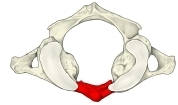 Atlas (superior view)
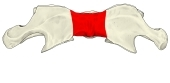 Atlas (anterior view)
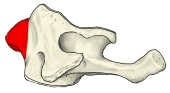 Atlas (left lateral view)
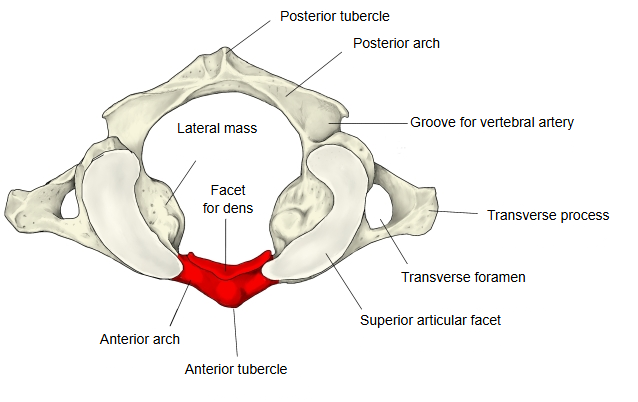
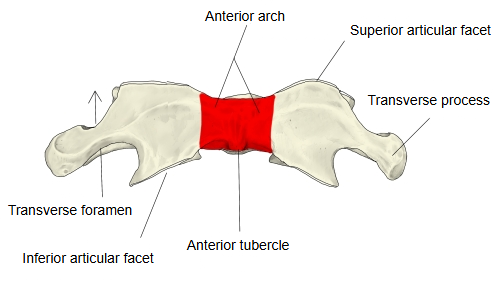
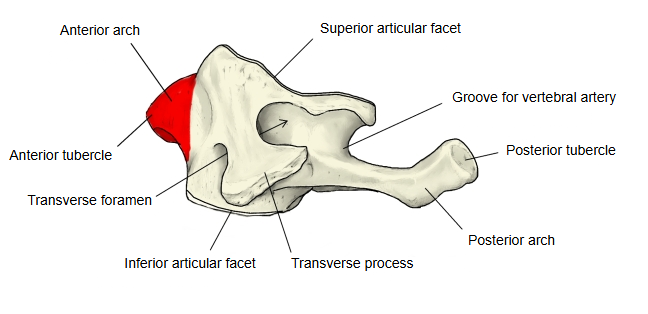
In more detail:
The anterior arch is the short, curved bar of bone that closes the ring of the atlas in front; the longer posterior arch closes it behind, and the two arches meet the lateral masses on each side. Its front surface is convex, with the anterior tubercle in the midline for the longus colli and the anterior longitudinal ligament. Its back surface is concave and carries a smooth, oval or round facet that articulates with the dens of the axis at the median atlanto-axial joint.
Its upper border gives attachment to the anterior atlanto-occipital membrane, which joins it to the front of the foramen magnum of the occipital bone; its lower border is joined to the axis by the anterior atlanto-axial membrane.
Related terms
- Atlas
- Posterior arch of atlas
- Lateral mass of atlas
- Axis
- Dens
- Anterior atlanto-occipital membrane
- Longus colli
References and sources
- Further reading: Atlas (anatomy), Wikipedia.
- Federative International Programme for Anatomical Terminology (FIPAT). Terminologia Anatomica, 2nd ed. (TA2), 2019.