Alpha-amino acids
Also called the &alpha or the -amino acids
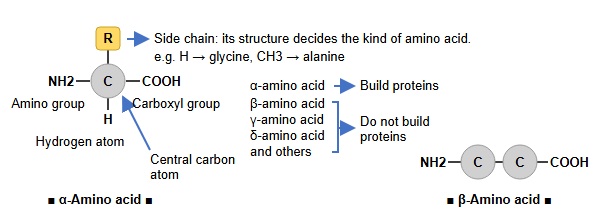
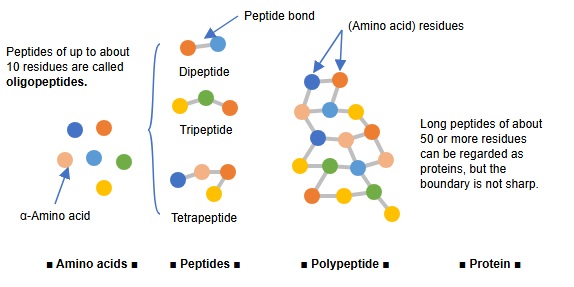
Alpha-amino acids are the amino acids that are the building units of proteins, i.e. amino acids in the narrow sense.
There are also amino acids that do not build proteins.
· In the broad sense, amino acids are all organic compounds that carry both an amino group (–NH2) and a carboxyl group (–COOH). In an alpha-amino acid the amino group is attached to the alpha carbon, the carbon next to the carboxyl group.
Examples of amino acids that do not build proteins
| 1 | Beta-alanine (a relative of alanine) | Found in muscle. |
| 2 | Ornithine | An intermediate of the urea cycle. |
| 3 | Creatine | Found in muscle. Strictly an amino acid derivative rather than an amino acid. |
| 4 | Gamma-aminobutyric acid | A neurotransmitter = GABA (gamma-aminobutyric acid). |
Classi-
fication of
amino acids
fication of
amino acids
- By the side chain : e.g. branched-chain amino acids, aromatic amino acids, sulfur-containing amino acids.
- By their breakdown products : glucogenic and ketogenic amino acids.
- By the position of the amino group : alpha-amino acids, beta-, gamma- and delta-amino acids.
- By optical isomerism : D- and L-amino acids.
- By nutrition : essential, conditionally essential and non-essential amino acids.
Reference websites
[Wikipedia]
· Amino acid, Wikipedia.
Related terms
References and sources
- Further reading: Alpha-amino acid (Amino acid), Wikipedia.
- Federative International Programme for Anatomical Terminology (FIPAT). Terminologia Anatomica, 2nd ed. (TA2), 2019.