Amino acids
Overview
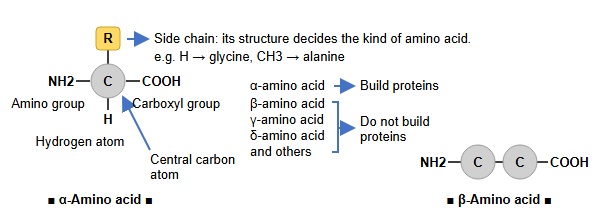
In the narrow sense, amino acids are the alpha-amino acids that are the building units of proteins.
· In the broad sense (especially in chemistry), the name covers all organic compounds that carry both an amino group (–NH2) and a carboxyl group (–COOH).
Examples of amino acids that do not build proteins
| 1 | Beta-alanine (a relative of alanine) | Found in muscle. |
| 2 | Ornithine | An intermediate of the urea cycle. |
| 3 | Creatine | Found in muscle. Strictly an amino acid derivative rather than an amino acid. |
| 4 | Gamma-aminobutyric acid | A neurotransmitter = GABA (gamma-aminobutyric acid). |
More than 80 kinds of amino acids occur in nature, but only about 20 of them build the proteins of the human body.
| Essential amino acids (9) | Non-essential amino acids (11) |
|---|---|
| Leucine, isoleucine, valine, methionine, threonine, tryptophan, lysine, phenylalanine, histidine | Glycine, alanine, serine, proline, asparagine, glutamine, cysteine, tyrosine, aspartic acid, glutamic acid, arginine |
| Conditionally essential amino acids (= semi-essential amino acids, 4–6): glutamine (the most abundant free amino acid in the body), arginine, tyrosine, cysteine (+ glycine, proline) | |
Classification
Classi-
fication of
amino acids
fication of
amino acids
- By the side chain : e.g. branched-chain amino acids, aromatic amino acids, sulfur-containing amino acids, acidic and basic amino acids.
- By their breakdown products : glucogenic amino acids (can be turned into glucose) and ketogenic amino acids (turned into ketone bodies or fatty acids); some are both.
- By the position of the amino group : alpha-, beta-, gamma- and delta-amino acids.
- By optical isomerism : D- and L-amino acids; the amino acids of human proteins are L-amino acids.
- By nutrition : essential, conditionally essential (semi-essential) and non-essential amino acids.
Top 10
The table below gives a simple overview of the ten amino acids present in the largest amounts in the body (in proteins and as free amino acids). The order differs between sources and is only approximate.
| Amino acid | Class | Features | |
|---|---|---|---|
| 1 | Glutamine | Non | The most abundant free amino acid; carries nitrogen; an important fuel for the cells of the immune system and the intestinal lining. |
| 2 | Alanine | Non | Carries nitrogen and carbon from muscle to the liver for gluconeogenesis (glucose–alanine cycle). |
| 3 | Glutamic acid | Non | Central in amino acid metabolism; the main excitatory neurotransmitter. |
| 4 | Leucine | Ess | A branched-chain amino acid; a signal for protein synthesis in muscle. |
| 5 | Lysine | Ess | An essential amino acid; helps to stabilise protein structure (e.g. cross-links in collagen). |
| 6 | Valine | Ess | A branched-chain amino acid; important in muscle metabolism. |
| 7 | Isoleucine | Ess | A branched-chain amino acid; used in energy metabolism. |
| 8 | Glycine | Semi | A main component of collagen; an inhibitory neurotransmitter. |
| 9 | Serine | Non | Used to make lipids and nucleic acids; a branch point of metabolism. |
| 10 | Proline | Non | A component of collagen; abundant in connective tissue. |
Reference websites
[Wikipedia]
· Amino acid, Wikipedia.
Related terms
References and sources
- Further reading: Amino acid, Wikipedia.
- Federative International Programme for Anatomical Terminology (FIPAT). Terminologia Anatomica, 2nd ed. (TA2), 2019.