Cementoblast (Latin: Cementoblastus)
From dental follicle cell to cementocyte
Function of the cementocyte: maintenance and repair of the cementum
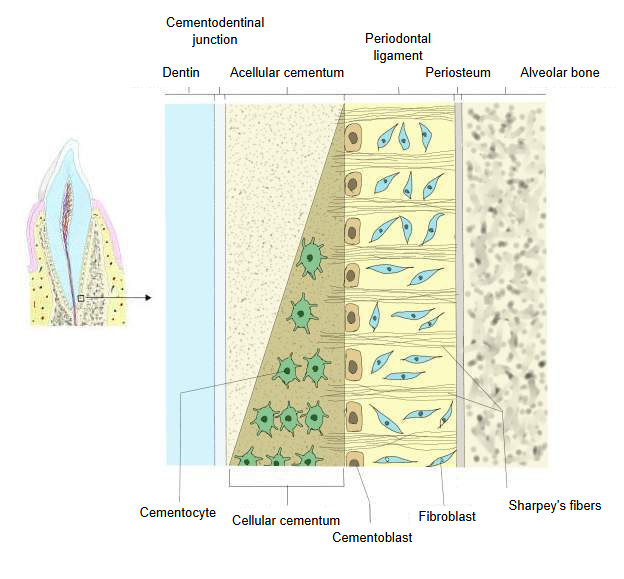
Cementoblasts develop from the cells of the dental follicle (dental sac) around the forming root of the tooth; sources differ on what triggers this, and the epithelial root sheath of Hertwig is thought to play a part. They form the cementum (cementogenesis), the hard tissue that covers the root. They resemble bone-forming osteoblasts but make cementum, not bone. In cellular cementum they become trapped in the matrix they make; they then lose most of their secretory activity and become cementocytes, each in its own cement lacuna. A layer of cementoblasts remains throughout life on the root surface, facing the periodontal ligament, and can add cementum when needed, for example after injury.
Reference websites
[Wikipedia]
· Cementoblast, Wikipedia.
· Cementum, Wikipedia.
Related terms
- Cementocyte
- Cellular cementum
- Acellular cementum
- Cement lacuna
- Periodontal ligament
- Periodontium
- Osteoblast
- Dental tissue
References and sources
- Further reading: Cementoblast, Wikipedia.
- Further reading: Cementum, Wikipedia.
- Federative International Programme for Anatomical Terminology (FIPAT). Terminologia Anatomica, 2nd ed. (TA2), 2019.