Cytoskeleton (Latin: cytoskeleton)
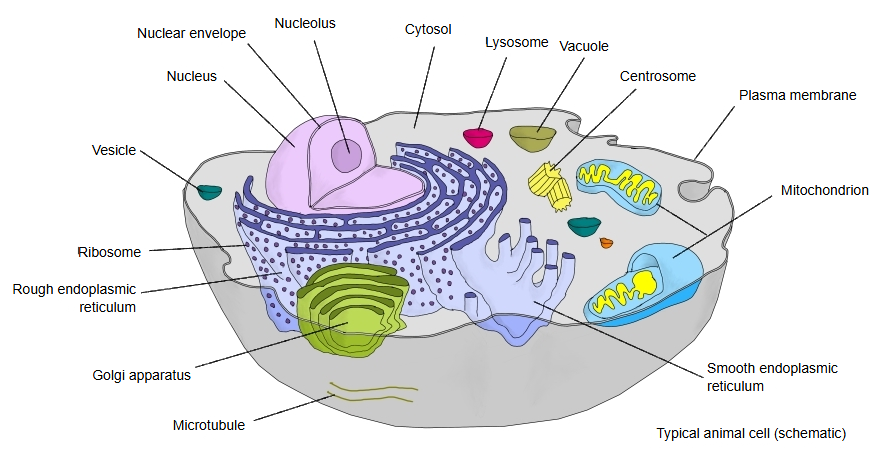
The cytoskeleton is a network of fibrous protein structures inside every cell of the body that keeps the shape of the cell. It runs through the whole cytoplasm, from around the nucleus to just under the plasma membrane. It is sometimes listed with the organelles, but because it has no surrounding membrane it is often not counted as one; sources differ.
More details
Types
There are three main kinds, which differ in thickness and protein.
| 1 | Microfilament (actin filament) | Diameter about 6–7 nm (1 nm = one millionth of a millimetre). Two strands of the protein actin twisted into a helix; the thinnest of the three. |
| 2 | Intermediate filament | Diameter about 10 nm. Built from several different proteins depending on the cell type, such as keratin in epithelial cells and neurofilament proteins in neurons. |
| 3 | Microtubule | The thickest: hollow tubes about 25 nm across, made of the protein tubulin. |
Functions
Keeping the shape of the cell: the filaments resist pulling forces; intermediate filaments are the most important for mechanical strength.
Moving material within the cell: vesicles and organelles are carried along microtubules and actin filaments. Actin filaments also move the cell surface and pinch the cell in two at division, and microtubules form the spindle that separates the chromosomes.
Related terms
References and sources
- Further reading: Cytoskeleton, Wikipedia.
- Federative International Programme for Anatomical Terminology (FIPAT). Terminologia Anatomica, 2nd ed. (TA2), 2019.