Microtubule (Latin: microtubulus)
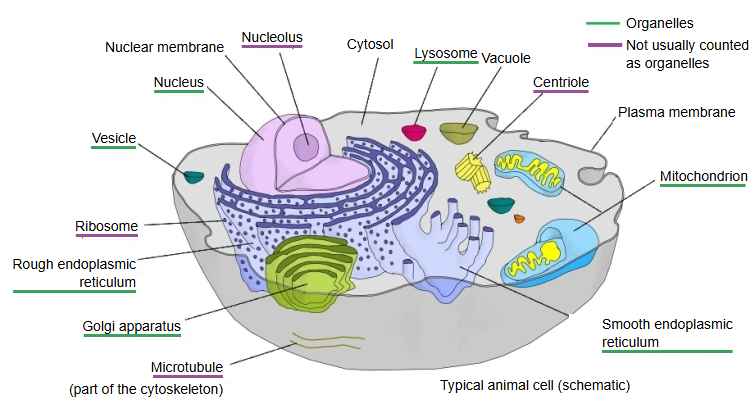
One of the parts of the cytoskeleton, a structure inside each cell of our body that is sometimes counted among the organelles (because it has no surrounding membrane, it is often not counted as one; sources differ).
- Microfilaments (actin filaments)
- Intermediate filaments
- Microtubules
of the
cell
- Cell membrane : phospholipid bilayer, membrane proteins, sugar chains.
- Cytoplasm
- Cytosol : water, electrolytes, metabolic enzymes, free amino acids, metabolic intermediates.
- Organelles : mitochondria, endoplasmic reticulum, centrosome, Golgi apparatus, lysosomes, peroxisomes, vesicles (some sources do not count vesicles as organelles).
- Cytoskeleton : microtubules, actin filaments, intermediate filaments.
- Nucleus : nuclear envelope, nucleoplasm, chromatin, nucleolus; the nucleus is also counted among the organelles.
More details
Structure
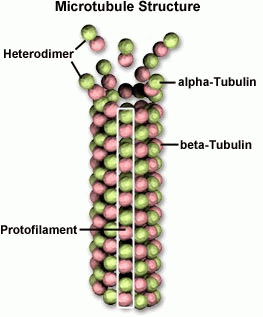
A hollow, tube-shaped structure about 25 nm across, made mainly of the protein tubulin: pairs of alpha- and beta-tubulin line up into protofilaments, and usually 13 protofilaments form the wall of the tube. The tubes grow and shrink at their ends. Of the three kinds of cytoskeletal filament, microtubules are the thickest.
⇒ An illustration of the structure of a microtubule
Functions
Keeping the shape of the cell: together with the other cytoskeletal filaments, microtubules help to keep the shape of the cell.
In cell division microtubules form the mitotic spindle, which separates the chromosomes. They radiate from the centrosome near the nucleus and act as tracks along which motor proteins carry vesicles and organelles. They also form the core of centrioles, cilia and the sperm tail.
Other useful sites
· An illustration of the structure of a microtubule
Related terms
References and sources
- Further reading: Microtubule, Wikipedia.
- Federative International Programme for Anatomical Terminology (FIPAT). Terminologia Anatomica, 2nd ed. (TA2), 2019.