Dental tubercle (Latin: tuberculum dentis)
Tubercle, cusp and cusp tip
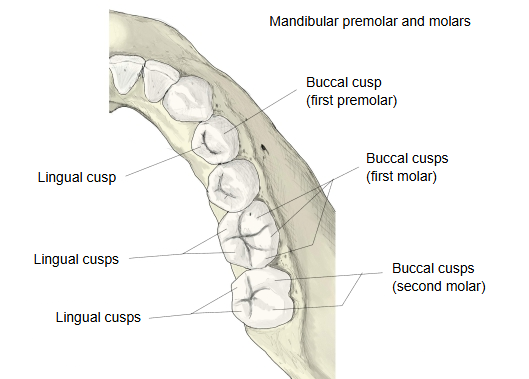
The words tubercle and cusp are used in overlapping ways, and textbooks do not all agree on them.
1. Many texts call each rounded elevation of the occlusal surface, raised between the grooves of the crown, a dental tubercle and treat it as the same thing as a cusp.
In English dental anatomy, however, these large elevations are usually called cusps, and "tubercle" is kept for smaller extra elevations, such as the cingulum on the lingual surface of incisors and canines or Carabelli's tubercle of the upper first molar. Terminologia Anatomica lists the dental tubercle and the cusp of tooth as separate terms. Sources differ.
2. The highest point of a cusp is called the cusp tip (apex of the cusp).
Reference websites
[Wikipedia]
· Cusp (anatomy), Wikipedia.
· Cingulum (tooth), Wikipedia.
[Websites with illustrations]
· Cusps of the molars (figure) (Elsevier)

· Mandibular first molar, occlusal view (Shutterstock (image))

Related terms
- Neck of tooth
- Root of tooth
- Apex of root of tooth
- Pulp cavity of crown
- Crown
- Premolar
- Permanent teeth
- Teeth
References and sources
- Further reading: Cusp (anatomy), Wikipedia.
- Further reading: Cingulum (tooth), Wikipedia.
- Federative International Programme for Anatomical Terminology (FIPAT). Terminologia Anatomica, 2nd ed. (TA2), 2019.