Efferent arteriole (Latin: arteriola glomerularis efferens)
Also called the efferent glomerular arteriole
Overview
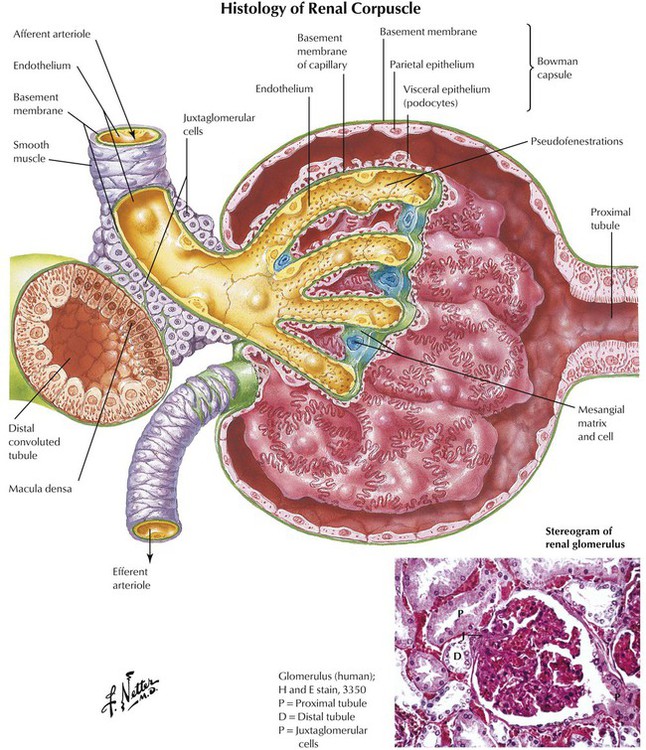
· The efferent arteriole is the arteriole into which the capillaries of the glomerulus join again; it leaves the renal corpuscle at the vascular pole.
· It carries blood out of the glomerulus and is narrower than the afferent arteriole; this difference in width helps to build up the glomerular filtration pressure.
· Unlike other capillary beds, the glomerular capillaries drain into an arteriole, not a venule.
· What happens next depends on the position of the nephron:
Cortical nephrons: the efferent arteriole soon breaks up into a capillary network around the tubules (the peritubular capillaries), which supplies the cortex.
Juxtamedullary nephrons: many efferent arterioles give rise to the vasa recta (straight arterioles), which run straight down into the medulla alongside the loops of Henle.
· Angiotensin II constricts it strongly; when blood pressure falls, this keeps up the pressure inside the glomerulus and so maintains the glomerular filtration rate.
Reference websites
[Wikipedia]
· Efferent arteriole, Wikipedia.
· Afferent arterioles, Wikipedia.
[Websites with illustrations]
· Glomerular filtration (University of Chicago Kidney Stone Program)
· Renal corpuscle (2D functional tissue unit) (Human Reference Atlas)
· Histology of the renal corpuscle (illustration) (Basicmedical Key)
Related terms
- Glomerulus
- Glomerular capillary
- Renal corpuscle
- Vascular pole
- Juxtamedullary nephron
- Cortical nephron
References and sources
- Further reading: Efferent arteriole, Wikipedia.
- Federative International Programme for Anatomical Terminology (FIPAT). Terminologia Anatomica, 2nd ed. (TA2), 2019.