Enterochromaffin cell
Also called EC cell or Kulchitsky cell
- Overview
- Actions of serotonin
- Questions and answers
- Reference websites
- (Wikipedia, websites with illustrations)
- Related terms
Overview
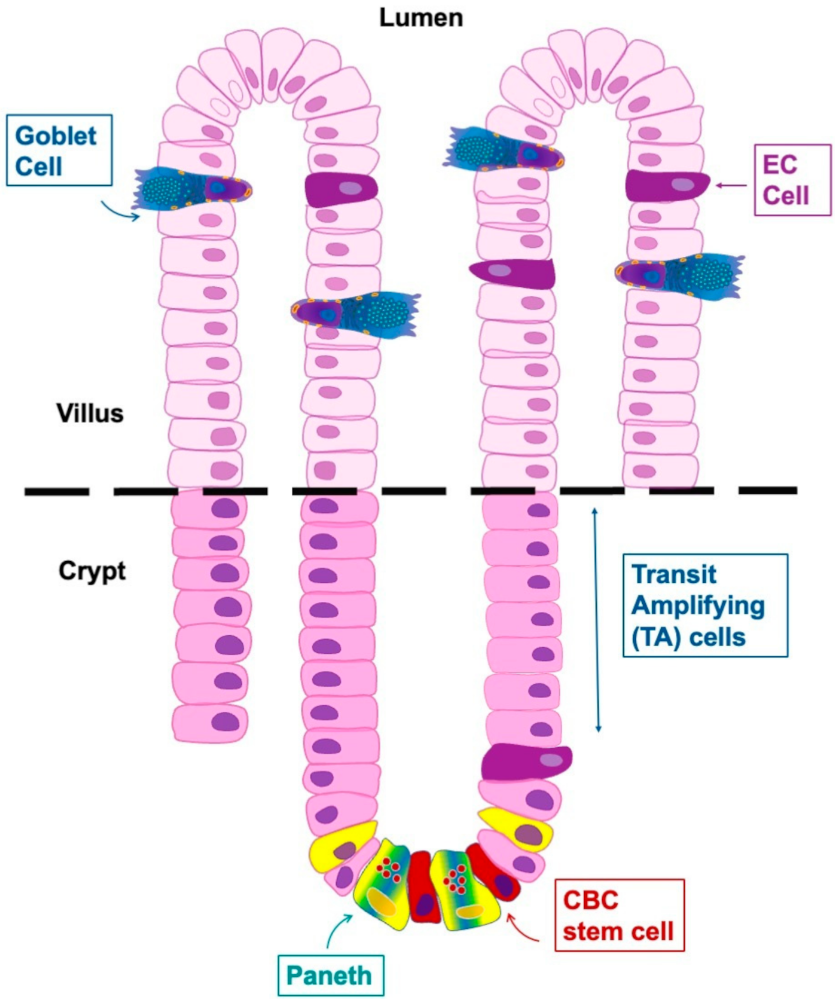
It lies singly among the other epithelial cells, mostly in the intestinal crypts. Its narrow tip reaches the lumen, and its secretory granules are stored at the base of the cell, next to the lamina propria, so the serotonin is released toward the tissue below.
Nervous-system property: it senses stimuli and releases a substance that acts on nerves (serotonin).
Endocrine property: it produces about 90% or more of the serotonin (5-HT) in the body.
Actions of serotonin
The serotonin released from enterochromaffin cells acts mainly on:
· the sensory nerve endings of the enteric nervous system (ENS)
· afferent fibres of the vagus nerve
· smooth muscle (indirectly)
Through these it takes part in:
· starting and adjusting peristalsis
· adjusting secretory reflexes
· adjusting gut sensations (discomfort, pain, nausea)
Questions and answers
Q: What does "chromaffin" mean?
A: It is the property of staining strongly with stains that contain chromium salts (chromates).
Broken down, "chromaffin" means:
chrom- (chromium): chromium salts (for example potassium dichromate)
-affin (affinity): reacting readily, binding to and being stained easily
So it means "the granules stain brown to dark brown when treated with chromium salts".
Why do enterochromaffin cells stain?
The secretory granules of enterochromaffin cells contain much
serotonin (5-HT)
and other indoleamines,
and these are oxidized by the chromium salts and become coloured.
Q: Is it known what proportion of the cells are enterochromaffin cells?
A: In short, enterochromaffin cells (EC cells) make up roughly 0.2–2% of the mucosal epithelium, with clear differences between regions.
Note: estimates for normal human tissue from immunostaining and other methods; figures vary between sources.
Approximate share of EC cells by region (rough guide)
| Region | Share of the mucosal epithelium | Features | |
|---|---|---|---|
| 1 | Stomach (especially the body) | 0.1–0.3% | Few; the main endocrine cells there belong to other types |
| 2 | Duodenum | about 0.2–0.4% | Numbers begin to rise |
| 3 | Jejunum | about 0.4–0.8% | Respond to nutrient stimuli |
| 4 | Ileum | about 0.8–1.2% | EC cells clearly more numerous |
| 5 | Colon (large intestine) | about 1–2% | One of the regions with the most |
Note 1: relation to all the endocrine cells
All the enteroendocrine cells together make up about 1% of the intestinal epithelium.
Among them, EC cells are the largest subtype (about 30–60%).
So they are "many among the endocrine cells, but a small minority of the whole epithelium".
Note 2: why the regions differ
From the ileum to the large intestine
the contents stay longer, and
mechanical and chemical stimuli are stronger,
so more EC cells are needed to regulate peristalsis and secretion.
Reference websites
[Wikipedia]
· Enterochromaffin cell, Wikipedia.
· Enteroendocrine cell, Wikipedia.
[Websites with illustrations]
· EC cells, goblet cells and Paneth cells along the crypt and villus (figure) (International Journal of Molecular Sciences (MDPI))
· Serotonin release from EC cells to nerves and blood (figure) (Elsevier)

· Enteroendocrine cell in the gut epithelium (figure) (UNC School of Medicine)

Related terms
- Enteroendocrine cell
- Intestinal crypts
- Enterocyte
- Paneth cell
- Enteric nervous system
- Small intestine
- Large intestine
References and sources
- Further reading: Enterochromaffin cell, Wikipedia.
- Further reading: Enteroendocrine cell, Wikipedia.
- Federative International Programme for Anatomical Terminology (FIPAT). Terminologia Anatomica, 2nd ed. (TA2), 2019.