Enteroendocrine cell
Also called Enteroendocrine cells or the gut endocrine cell or EEC
- Overview
- Questions and answers
- Reference websites
- (Wikipedia, websites with illustrations)
- Where it is found
- Related terms
Overview
· They secrete the gastrointestinal hormones that control the secretion of digestive juices (gastric acid, pancreatic juice, bile), the movements of the stomach and intestine, insulin release after a meal (the incretins GIP and GLP-1) and appetite (fullness signals to the brain).
Most are open cells whose narrow tip reaches the lumen and senses its contents. They store their hormones in granules at the base of the cell and release them into the lamina propria, close to capillaries and nerve endings. Like the other epithelial cells they arise from the stem cells of the crypts.
Main secretions
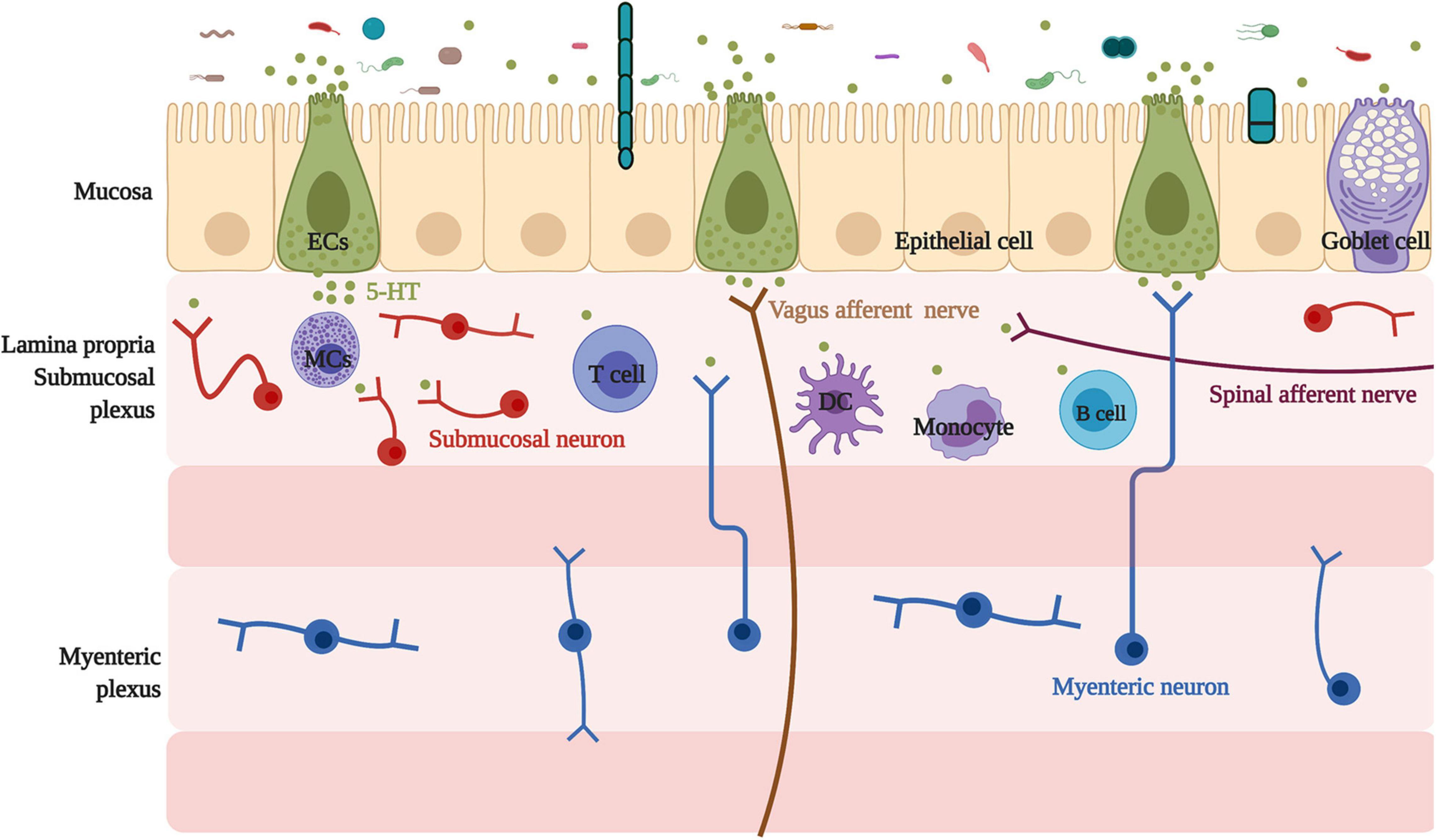
· Serotonin (5-HT): regulates gut movement and secretion
· Gastrin, CCK, GLP-1 and other gastrointestinal hormones
| Cell type | Main hormone | Main site | |
|---|---|---|---|
| 1 | Enterochromaffin (EC) cells | Serotonin (5-HT), affecting gut movement and secretion; the most numerous type | Throughout the gut |
| 2 | G cells | Gastrin | Pyloric part of the stomach |
| 3 | I cells | Cholecystokinin (CCK) | Duodenum and jejunum |
| 4 | S cells | Secretin | Duodenum |
| 5 | K cells | GIP (glucose-dependent insulinotropic peptide) | Duodenum and jejunum |
| 6 | L cells | GLP-1 and peptide YY | Ileum and colon |
| 7 | D cells | Somatostatin, which damps down the release of other gut hormones | Stomach and intestine |
· Most intestinal epithelial cells have a very short life of only about 4–7 days.
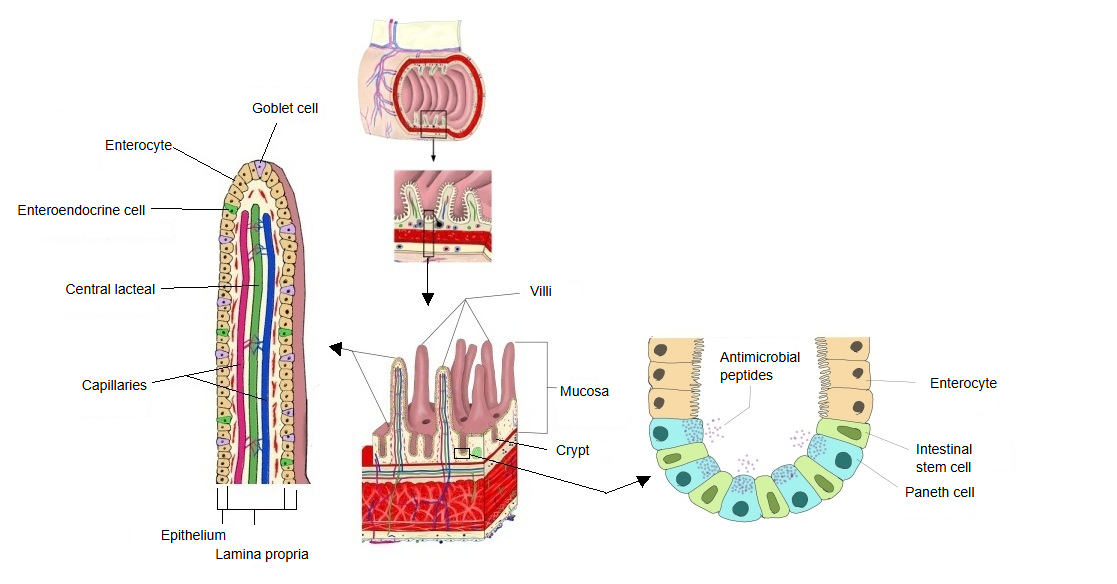
The table below is a short list of the epithelial cells of the mucosa of the small intestine.
| Cell type | Main function | Location | Share (approx.) | |
|---|---|---|---|---|
| 1 | Enterocytes | Absorption of nutrients; brush-border digestive enzymes | Villi and crypts | about 80–90% |
| 2 | Goblet cells | Secrete mucus | Villi and crypts | about 10–15% (varies by region) |
| 3 | Enteroendocrine cells | Secrete hormones | Crypts and villi | about 1–2% |
| 4 | Paneth cells | Secrete antimicrobial peptides | Base of the crypts | about 1–3% (mainly in the jejunum and ileum) |
| 5 | Stem cells | Renew the epithelium | Base of the crypts | very few (<1%) |
Questions and answers
Q: Are enteroendocrine cells not more numerous on the villi than in the crypts?
A: Enteroendocrine cells are found both on the villi and in the crypts, but the pattern of distribution differs with the type of cell.
1. 1. Structure of the small intestine and the distribution of its cells
Villi: made mainly of absorptive cells (enterocytes), with goblet cells and some enteroendocrine cells.
Crypts: many stem cells and dividing cells, with Paneth cells and some enteroendocrine cells.
2. 2. Distribution of enteroendocrine cells
Enteroendocrine cells are scattered in the epithelium from the intestinal crypts up to the villi.
Tendencies:
Types often described as more common on the villi: cells producing CCK, GLP-1 and others. The pattern differs between studies, as some cells change the hormones they make while moving up from the crypt.
Types more common towards the crypts: serotonin-producing (EC) cells may be seen more often near the crypts.
Reference websites
[Wikipedia]
· Enteroendocrine cell, Wikipedia.
· Enterochromaffin cell, Wikipedia.
[Websites with illustrations]
· Villus and crypt with the enteroendocrine cells among the other epithelial cells (Advances in Nutrition)

· An enteroendocrine cell: receptors and functions (Frontiers in Neuroscience)
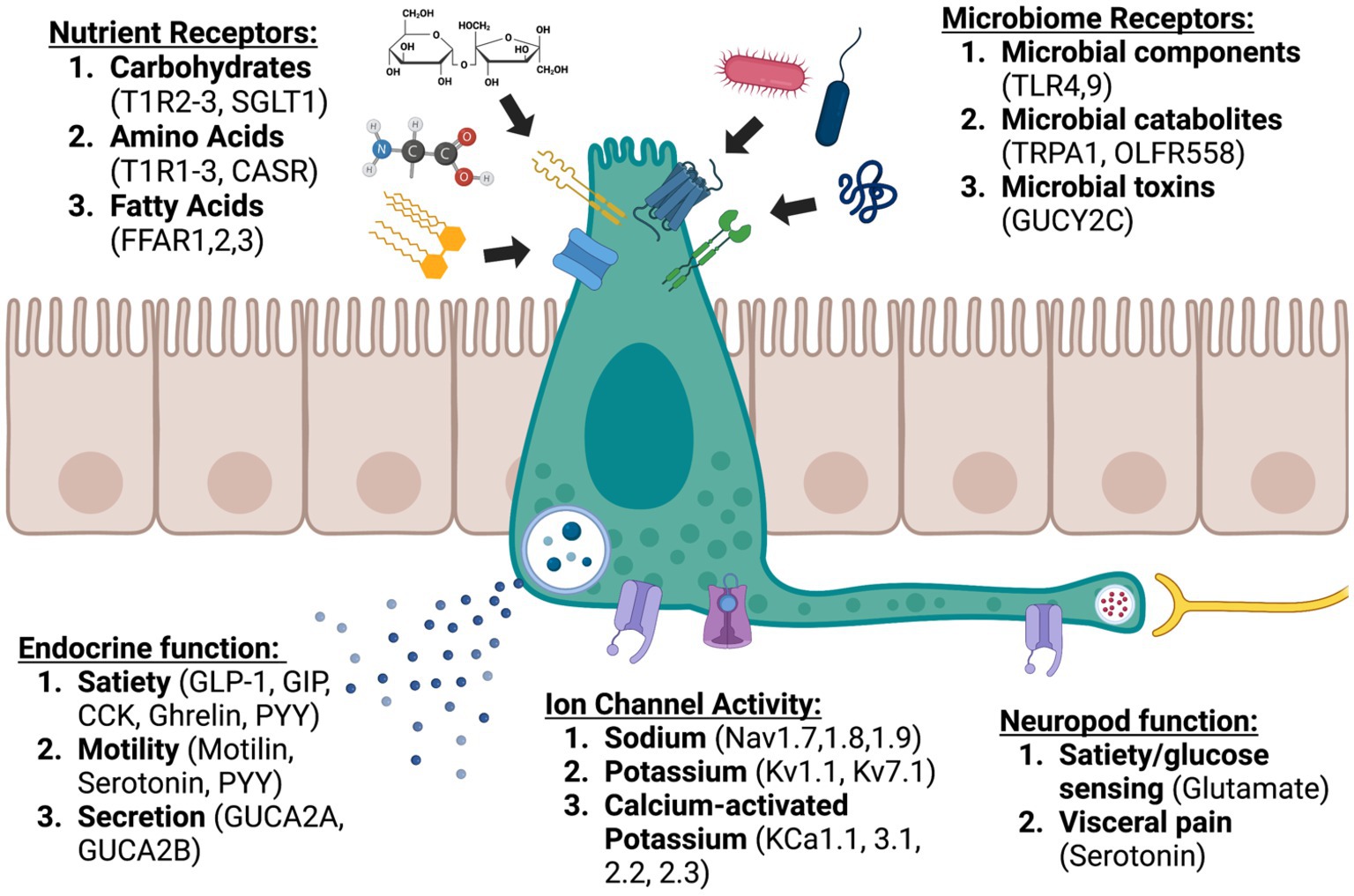
· Enterochromaffin cells, serotonin and the nerves of the gut wall (Frontiers in Cellular Neuroscience)
Where it is found
Related terms
References and sources
- Further reading: Enteroendocrine cell, Wikipedia.
- Further reading: Enterochromaffin cell, Wikipedia.
- Federative International Programme for Anatomical Terminology (FIPAT). Terminologia Anatomica, 2nd ed. (TA2), 2019.