Fila olfactoria (Latin: fila olfactoria (singular: filum olfactorium))
Also called the olfactory nerve filaments
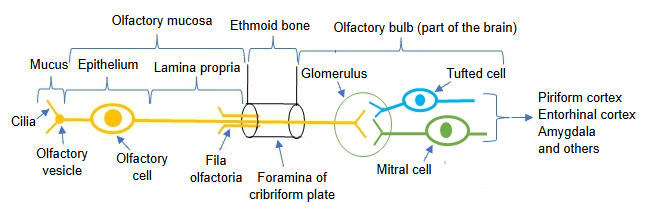
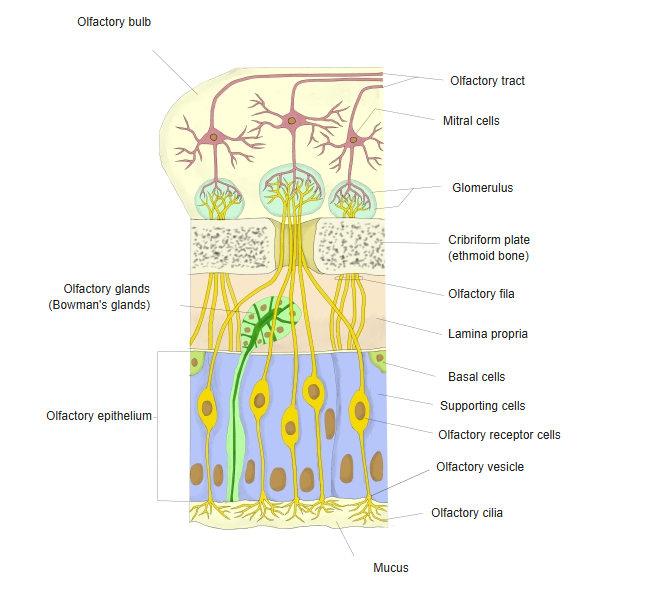
The axons of the olfactory cells that run towards the brain gather into small bundles, which pass through the small holes of the cribriform plate; these bundles are called the fila olfactoria. Together they make up the olfactory nerve.
Olfactory cells: bipolar nerve cells in the olfactory region of the nasal mucosa (olfactory epithelium)Cribriform plate: the thin horizontal plate of the ethmoid bone
Each fibre is the axon of an olfactory receptor cell (a bipolar nerve cell) in the olfactory epithelium (olfactory cells).
The thin, unmyelinated axons gather in the lamina propria into bundles, roughly 20 on each side.
The bundles pass through the small holes of the cribriform plate of the ethmoid bone and end in the glomeruli of the olfactory bulb, where they synapse with mitral and tufted cells.
Because they cross the cribriform plate, they can be torn in head injuries, causing loss of smell.
Related terms
- Olfactory nerve
- Olfactory epithelium
- Olfactory receptor cells
- Cribriform plate
- Olfactory glands
- Ethmoid bone
- Olfactory organ
References and sources
- Further reading: Olfactory nerve, Wikipedia.
- Federative International Programme for Anatomical Terminology (FIPAT). Terminologia Anatomica, 2nd ed. (TA2), 2019.