Bipolar neuron
Also called the bipolar cell, bipolar nerve cell
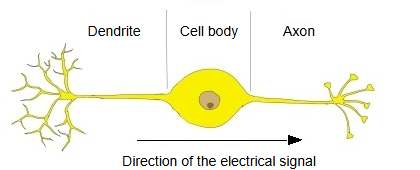
of nerve
cell
- Unipolar neuron : one process from the cell body. Found in the central nervous system of invertebrates; true unipolar neurons are rare in humans.
- Bipolar neuron : two processes from the cell body (one dendrite and one axon). Found in special sense organs: the retina, the olfactory epithelium of the nose and the neurons of the vestibular and cochlear nerves. Share: a few % of all neurons.
- Multipolar neuron : many processes from the cell body. About 99% of the neurons of the central nervous system. Found in the cortex of the brain, the spinal cord and the autonomic ganglia. Share: over 90% of all neurons.
- Pseudounipolar neuron : one process from the cell body, which divides into two (a peripheral process and a central process: dendrite and axon); the signal can bypass the cell body. Share: a few % of all neurons.
They are found mainly in the following places:
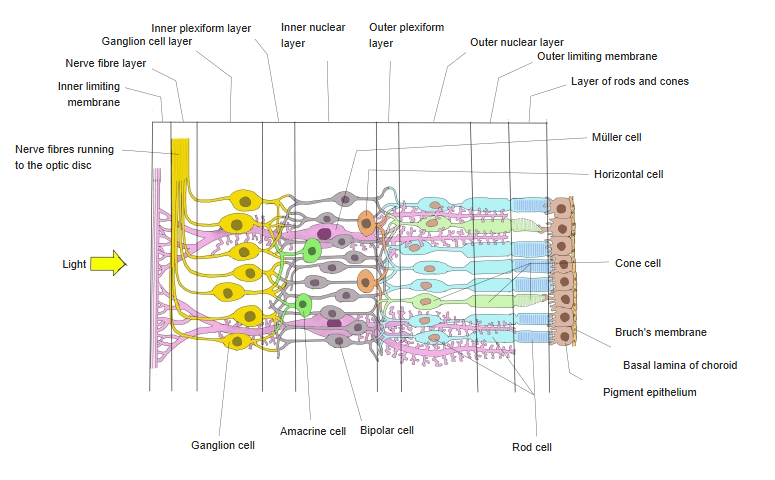
1. 1. Sight: the bipolar cells of the retina (unmyelinated), between the photoreceptors and the ganglion cells.
2. 2. Hearing and balance: the neurons of the cochlear nerve and vestibular nerve of the internal ear, whose cell bodies lie in the spiral ganglion and the vestibular ganglion (mostly myelinated).
3. 3. Smell: the olfactory receptor cells of the olfactory epithelium (essentially unmyelinated).
 Bipolar neuron
 Structure of the retina
- 1st to 3rd neurons
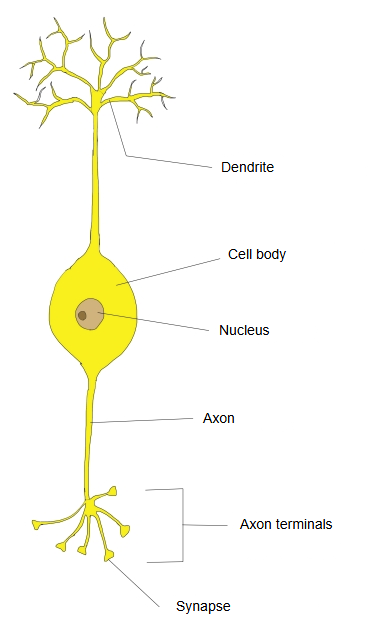
Reference websites
[Wikipedia]
· Bipolar neuron, Wikipedia.
· Retina bipolar cell, Wikipedia.
[Websites with illustrations]
· Bipolar cell pathways in the vertebrate retina (Webvision (University of Utah))
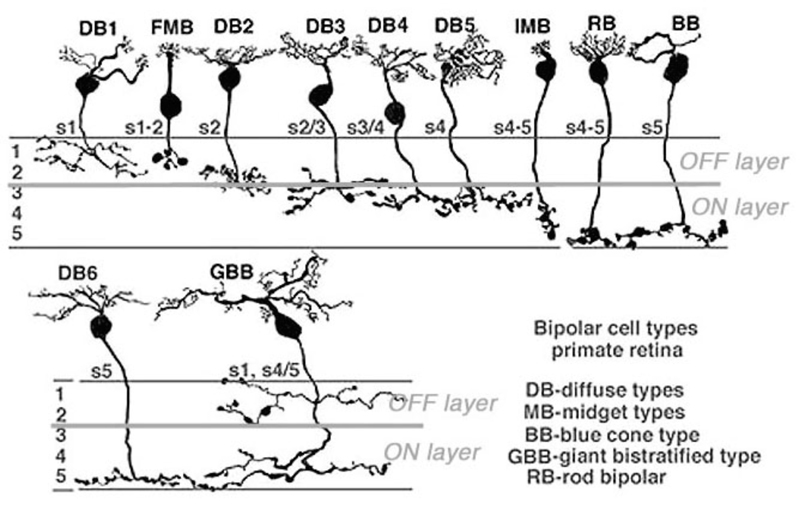
· Bipolar cell types of the primate retina (drawing) (Webvision (image))
· Bipolar neuron (icon drawing) (BioRender (image))

· Bipolar neurons (images) (Wikimedia Commons)
Structure of the retinal bipolar cell
Retinal bipolar cells are named after their shape: two sets of processes leave a central cell body. In mammals each one receives synapses from either rods or cones, not both (mixed input is known only in some fish), and it is also influenced by the horizontal cells. It passes the signal on to the ganglion cells, directly or through amacrine cells. Unlike most neurons, bipolar cells signal with graded potentials rather than action potentials.
Related terms
- Neuron
- Multipolar neuron
- Unipolar neuron
- Pseudounipolar neuron
- Retinal ganglion cell
- Olfactory cell
- Spiral ganglion
References and sources
- Further reading: Bipolar neuron, Wikipedia.
- Further reading: Retina bipolar cell, Wikipedia.
- Federative International Programme for Anatomical Terminology (FIPAT). Terminologia Anatomica, 2nd ed. (TA2), 2019.