Foramen cecum of frontal bone (Latin: foramen caecum ossis frontalis)
Also called the foramen caecum
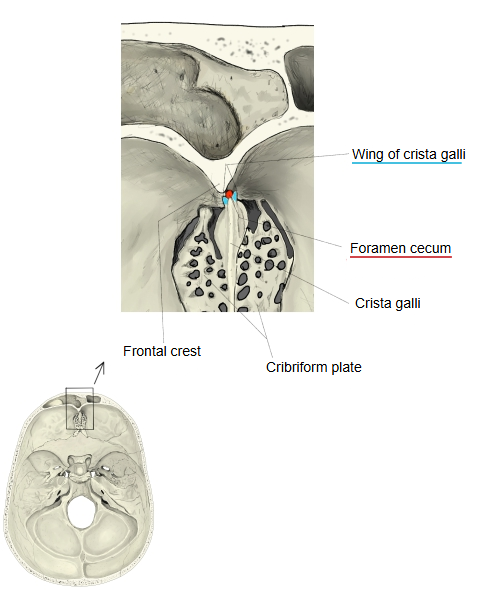
The foramen cecum is a small hole at the lower end of the frontal crest of the frontal bone, formed by the frontal crest and the alae of the crista galli of the ethmoid bone.
Lower end of the frontal crest: at the front end of the midline of the cerebral (inner) surface of the frontal boneAlae of the crista galli: small projections that spread to each side from the front end of the crista galli
· In some skulls the foramen cecum is formed entirely by the frontal bone.
· Its size varies from person to person, and it is often closed.
What passes through it: a small process of the dura mater and, when it is open, a small emissary vein from the nasal cavity to the superior sagittal sinus. Some texts mention only the dura, others only the vein; the vein is found more often in children than in adults.
· The canal runs downwards and forwards as far as the region of the nasal spine of the frontal bone, where it ends blindly; hence the name 'blind foramen'.
Reference websites
[Wikipedia]
· Foramen cecum (frontal bone), Wikipedia.
[Websites with illustrations]
· Base of the skull, internal surface (photograph) (Wikimedia Commons)

· Sagittal section of the skull with the emissary vein of the foramen cecum (Gray's Anatomy) (Wikimedia Commons)

Related terms
- Frontal crest
- Crista galli
- Ala of crista galli
- Cribriform plate
- Anterior cranial fossa
- Nasal spine of frontal bone
References and sources
- Further reading: Foramen cecum (frontal bone), Wikipedia.
- Federative International Programme for Anatomical Terminology (FIPAT). Terminologia Anatomica, 2nd ed. (TA2), 2019.