Hepatic segments (Latin: segmenta hepatis)
Also called the liver segments or Couinaud segments
See also the functional division in the liver entry.
· The division follows the vessels inside the liver, not the surface lobes, so the functional right and left halves differ from the anatomical right and left lobes.
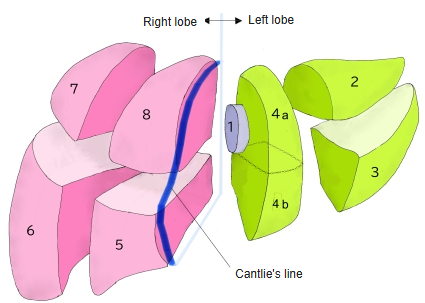
· The functional right and left liver are separated by Cantlie's line, an imaginary plane from the gallbladder fossa to the inferior vena cava, along the middle hepatic vein. The falciform ligament, which divides the anatomical lobes, lies further to the left.
· In the most widely used scheme (Couinaud), the liver has eight segments, numbered I to VIII.
· Because each segment has its own blood supply and bile drainage, a single segment can be removed in surgery (segmentectomy) without harming the rest.
[Boundaries]
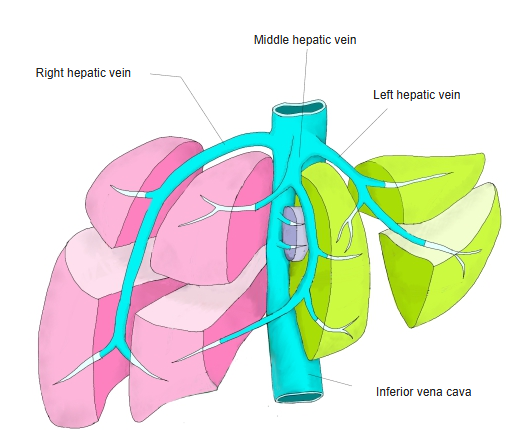
· Three vertical planes, one along each hepatic vein (right, middle and left), divide the liver into four parts (sectors).
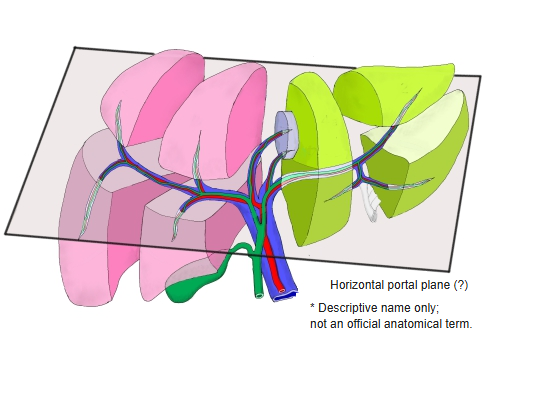
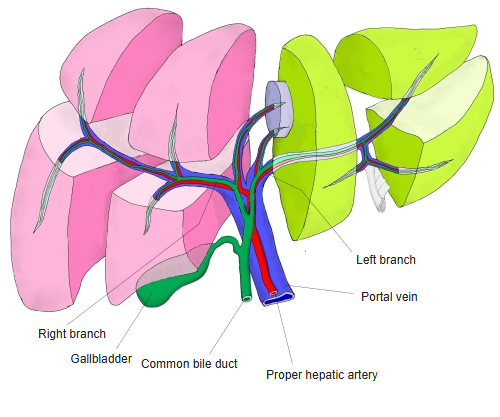
· A horizontal plane through the right and left branches of the portal vein divides these into upper and lower segments.
· The right hepatic vein, middle hepatic vein and left hepatic vein therefore run between segments, while the portal pedicles run into the centre of each segment.
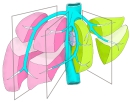 Vertical planes (hepatic veins)
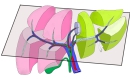 Horizontal plane (portal vein)
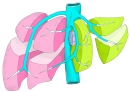 Segments and hepatic veins
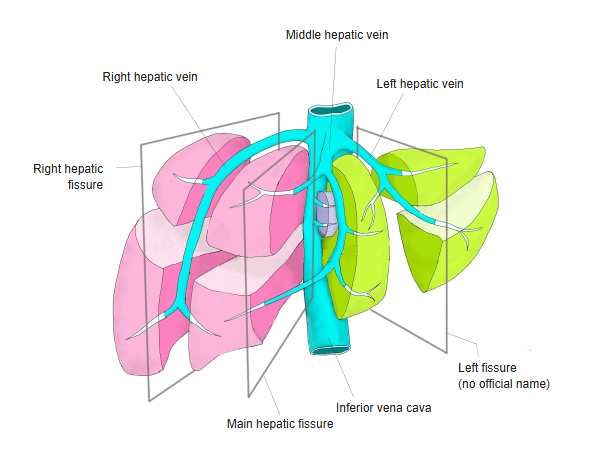
[Couinaud segments]
· I: the caudate lobe. It receives branches from both the right and left vessels and drains directly into the inferior vena cava, so it is often treated as independent.
· II and III: the left lateral part of the left liver, II above and III below.
· IV: the left medial part, between the falciform ligament and Cantlie's line; often split into IVa (upper) and IVb (lower, roughly the quadrate lobe).
· V and VIII: the right anterior part, V below and VIII above.
· VI and VII: the right posterior part, VI below and VII above.
· Seen from the front, the numbers run roughly clockwise from the caudate lobe.
 Segments and Cantlie's line
 Segments and portal vein
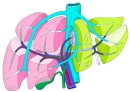 Segments and vessels
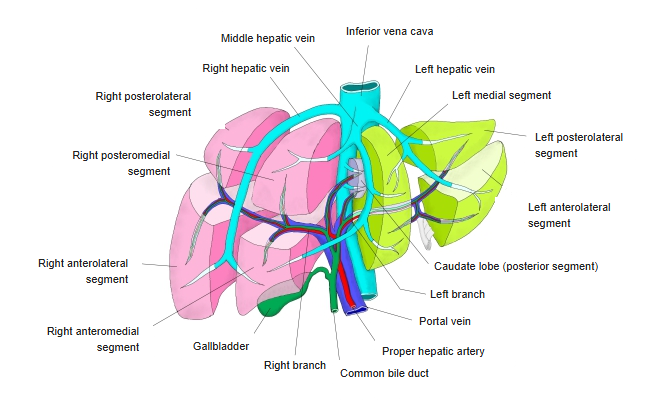
[Terminology]
· The Brisbane 2000 terminology groups the segments into sections: right posterior (VI, VII), right anterior (V, VIII), left medial (IV) and left lateral (II, III).
· An older scheme by Healey and Schroy divides the liver mainly by the arteries and bile ducts and splits the caudate lobe into further parts.
· Sources differ in the descriptive names given to each segment (for example, anterior or posterior, medial or lateral), so the Roman numerals are the safest way to refer to them.
Where it is found
Related terms
References and sources
- Further reading: Liver segment, Wikipedia.
- Further reading: Couinaud classification, Wikipedia.
- Federative International Programme for Anatomical Terminology (FIPAT). Terminologia Anatomica, 2nd ed. (TA2), 2019.