Cantlie's line
Also called Cantlie line or the main portal fissure (the plane)
· The plane through the line, the main portal fissure, contains the middle hepatic vein. Each side has its own branches of the portal vein, hepatic artery and bile duct.
· The anatomical division into right lobe and left lobe follows the falciform ligament instead, which lies further to the left. The quadrate lobe therefore belongs to the anatomical right lobe but to the functional left liver. The right portal fissure divides the right liver further.
· It is the line along which a right or left hepatectomy is made, and the basis of the hepatic segments.
 Cantlie's line
 Vertical planes of the liver
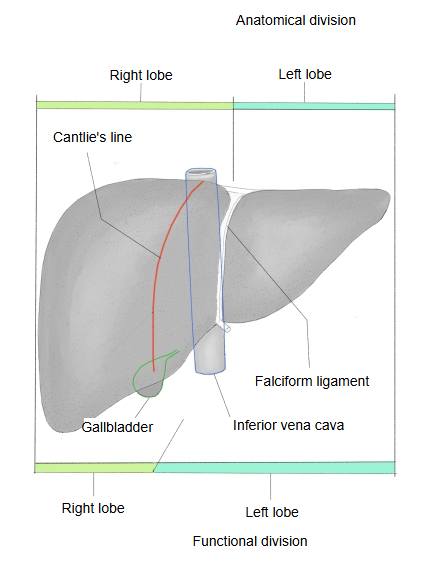
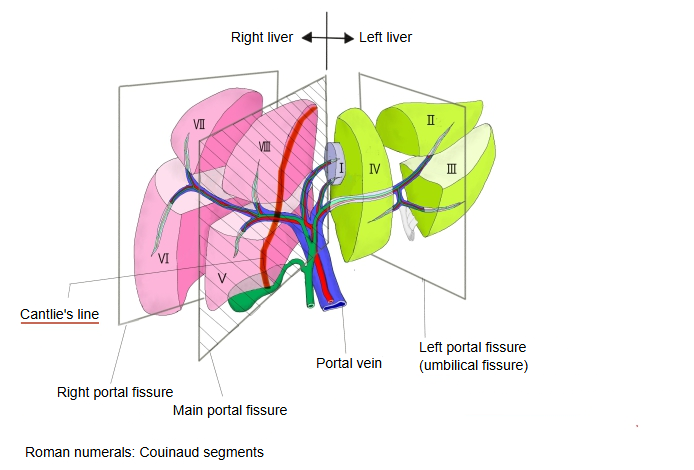
Reference websites
[Wikipedia]
· Liver segment, Wikipedia.
· Cantlie line, Wikipedia.
[Websites with illustrations]
· Liver: segmental anatomy (Radiology Assistant)
· Couinaud classification of hepatic segments (Radiopaedia)
Related terms
- Hepatic segments
- Right portal fissure
- Right lobe of liver
- Left lobe of liver
- Quadrate lobe
- Middle hepatic vein
- Liver
References and sources
- Further reading: Liver segment, Wikipedia.
- Further reading: Cantlie line, Wikipedia.
- Federative International Programme for Anatomical Terminology (FIPAT). Terminologia Anatomica, 2nd ed. (TA2), 2019.