Intracellular fluid
Also called ICF
Overview
· The inside of a cell is filled with intracellular fluid, in which the organelles and the nucleus lie. It is the cytosol of the cytoplasm, kept separate from the extracellular fluid by the plasma membrane.
(The nucleus also contains fluid, the nucleoplasm, which is also part of the intracellular fluid.)
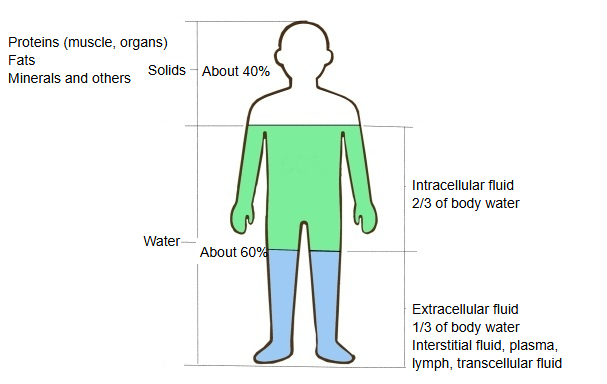
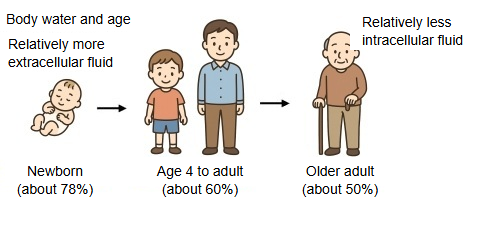
How the proportions of intracellular and extracellular fluid change with age
| Age | Intracellular fluid | Extracellular fluid | Comment | |
|---|---|---|---|---|
| 1 | Newborn | Relatively less | Relatively more | Newborns have a large body surface for their size and tend to have more extracellular fluid. |
| 2 | Adult | Standard | Standard | About 60% of body weight is water; intracellular to extracellular fluid is roughly 2 : 1. |
| 3 | Older adult | Decreases | Relatively larger share | Intracellular fluid falls mainly because muscle mass is lost; muscle holds much water, so less muscle means less intracellular fluid. |
Composition
Inorganic ions
Inorganic ions in the intracellular and extracellular fluid compared
| Ion | Intracellular fluid | Extracellular fluid | Comment | ||
|---|---|---|---|---|---|
| 1 | Cations | Na⁺ (sodium) | about 10–15 mEq/L | about 140 mEq/L | High outside the cells; the main factor in keeping up the osmotic pressure |
| 2 | K⁺ (potassium) | about 140 mEq/L | about 4 mEq/L | High inside the cells; important for the membrane potential | |
| 3 | Ca²⁺ (calcium) | about 0.0001 mEq/L (very low) | about 2.5 mEq/L | High outside the cells; involved in nerve activity and muscle contraction | |
| 4 | Mg²⁺ (magnesium) | about 20–30 mEq/L | about 1–2 mEq/L | Abundant inside the cells; helps enzymes work | |
| 5 | Anions | Cl⁻ (chloride) | about 4 mEq/L | about 100 mEq/L | The main anion of the extracellular fluid |
| 6 | HCO₃⁻ (bicarbonate) | about 10 mEq/L | about 24 mEq/L | Important for acid–base balance | |
| 7 | PO₄³⁻ (phosphate) | about 75 mEq/L | about 1–2 mEq/L | High inside the cells; part of ATP and DNA | |
| 8 | SO₄²⁻ (sulphate) | about 1 mEq/L | about 1 mEq/L | Low both inside and outside the cells |
Unit: mEq/L (milliequivalents per litre); 1 mEq/L means 1 milliequivalent of the ion in 1 litre of solution. The values are approximate; sources differ.
Functions
1. 1. Site of chemical reactions: almost all of metabolism (glycolysis, protein synthesis, cell division and so on) takes place in the intracellular fluid.
2. Ion balance: the differences in concentration inside and outside the cell, kept up by the plasma membrane, make nerve impulses, muscle contraction and the transport of substances possible.
3. 3. Osmotic balance: the osmotic pressure inside and outside the cell is kept equal, so that the cell neither shrinks nor swells.
4. Storage: it is also where sugar (glycogen), fat droplets, amino acids and other substances are stored.
Related terms
- Cytoplasm
- Extracellular fluid
- Body fluid
- Transcellular fluid
- Organelle
- Nucleoplasm
- Plasma membrane
- Cell nucleus
References and sources
- Further reading: Intracellular fluid, Wikipedia.
- Further reading: Fluid compartments, Wikipedia.
- Federative International Programme for Anatomical Terminology (FIPAT). Terminologia Anatomica, 2nd ed. (TA2), 2019.