Extracellular fluid
Also called ECF
Overview
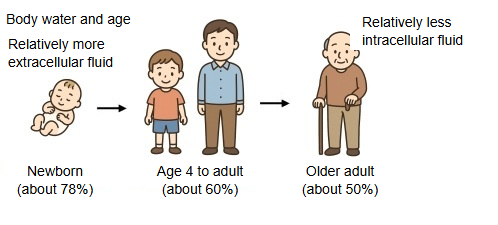
Change with age in the share of intracellular fluid and extracellular fluid
| Age | Intracellular fluid | Extracellular fluid | Comment | |
|---|---|---|---|---|
| 1 | Newborn | Relatively less | Relatively more | Newborns have a large body surface for their size and relatively more extracellular fluid than adults. |
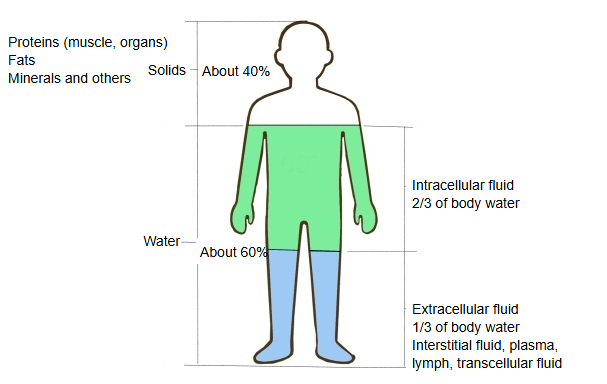
| 2 | Adult | Standard | Standard | About 60% of body weight is water; intracellular and extracellular fluid are roughly in the ratio 2 : 1. Extracellular fluid is about one third of body water, roughly 20% of body weight. |
| 3 | Older adult | Decreases | Share rises relatively | Intracellular fluid falls mainly because muscle is lost: muscle holds much water, so less muscle means less intracellular fluid. |
Types
Extracellular fluid consists of the plasma, the lymph, the interstitial fluid (tissue fluid) and the transcellular fluid. It surrounds and bathes every cell, bringing oxygen and nutrients and taking away waste.
in the
body
- Intracellular fluid : the fluid inside the cells: about two thirds of body fluid, about 40% of body weight. (Some texts do not count it as body fluid.)
- Extracellular fluid : about one third of body fluid
- Interstitial fluid : about 70-75% of the extracellular fluid; fills the spaces around the cells (between cells, and between cells and capillaries).
- Plasma : about 20-25%; the liquid part of the blood left when the blood cells (red and white blood cells and others) are removed.
- Lymph : about 1-2%; interstitial fluid that has entered the lymphatic vessels.
- Transcellular fluid : about 1-2%; special fluids enclosed by a layer of epithelial cells, such as cerebrospinal fluid and synovial fluid. Some texts do not count it as extracellular fluid; sources differ.
- Body fluid in all : about 60% of body weight in an adult
Is extracellular fluid 0.9% saline?
Extracellular fluid is often described as the internal environment of the body, roughly a 0.9% salt solution (physiological saline), with the same salt content as amniotic fluid and the ancient sea in which life began. How accurate is this?
In short: 'extracellular fluid = 0.9% salt' is close but not strictly correct, and the same is true of plasma.
Why 0.9%? Physiological saline (0.9% sodium chloride) was chosen to be nearly isotonic with extracellular fluid, so that red blood cells placed in it do not swell or burst. It is the solution most used in clinical practice, so textbooks often say for simplicity that the salt content of extracellular fluid is close to 0.9%.
What the fluid actually contains. Its sodium chloride content does not match 0.9% exactly. Approximate main ions:
Na⁺: about 135-145 mEq/L
Cl⁻: about 98-106 mEq/L
There are also HCO₃⁻, K⁺ and other ions, so the concentration cannot simply be expressed as '0.9% NaCl'.
Osmolality. Physiological saline (0.9% NaCl):
about 308 mOsm/L (calculated from the salt content)
Plasma and extracellular fluid:
about 285-295 mOsm/L
The calculated value is a little higher, but sodium chloride in solution does not act fully as separate ions (its osmotic coefficient is about 0.93), so the effective value is about 286 mOsm/L, close to that of plasma: in practice physiological saline is regarded as isotonic. Still, 0.9% saline is not the extracellular fluid itself, but an approximation that is not far off. The salt content of the blood (plasma) is not usually given as a mass percentage of NaCl, but converted from its osmolality:
plasma corresponds to roughly 0.85% NaCl.
This differs from the real concentration, because NaCl alone does not account for the osmolality.
The osmolality of plasma comes from electrolytes and from non-electrolytes such as glucose, urea and proteins, so physiology does not really use the term 'salt content' for it.
Table of inorganic ions
Inorganic ions in intracellular fluid and extracellular fluid compared (approximate values; sources differ)
| Ion | Intracellular fluid | Extracellular fluid | Comment | ||
|---|---|---|---|---|---|
| 1 | Cations | Na⁺ (sodium) | about 10-15 mEq/L | about 140 mEq/L | High outside the cells; the main factor in keeping osmotic pressure |
| 2 | K⁺ (potassium) | about 140 mEq/L | about 4 mEq/L | High inside the cells; important for the membrane potential | |
| 3 | Ca²⁺ (calcium) | about 0.0001 mEq/L (very low) | about 2.5 mEq/L | High outside the cells; involved in nerve activity and muscle contraction | |
| 4 | Mg²⁺ (magnesium) | about 20-30 mEq/L | about 1-2 mEq/L | Mostly inside the cells; helps enzyme activity | |
| 5 | Anions | Cl⁻ (chloride) | about 4 mEq/L | about 100 mEq/L | The main anion of extracellular fluid |
| 6 | HCO₃⁻ (bicarbonate) | about 10 mEq/L | about 24 mEq/L | Important for acid-base balance | |
| 7 | PO₄³⁻ (phosphate) | about 75 mEq/L | about 1-2 mEq/L | High inside the cells; part of ATP and DNA | |
| 8 | SO₄²⁻ (sulfate) | about 1 mEq/L | about 1 mEq/L | Low both inside and outside |
Unit: mEq/L (milliequivalents per litre); 1 mEq/L means 1 milliequivalent of the ion in 1 litre of solution. The difference between the sodium- and chloride-rich fluid outside the cells and the potassium-rich fluid inside them is kept up by pumps in the plasma membrane.
Related terms
- Intracellular fluid
- Body fluid
- Transcellular fluid
- Blood
- Serous fluid
- Synovial fluid
- Plasma membrane
References and sources
- Further reading: Extracellular fluid, Wikipedia.
- Further reading: Fluid compartments, Wikipedia.
- Federative International Programme for Anatomical Terminology (FIPAT). Terminologia Anatomica, 2nd ed. (TA2), 2019.