Labial commissure (Latin: commissura labiorum oris)
Also called the commissure of the lips or oral commissure.
A similar point is the angle of mouth. The angle of mouth is the right or left end of the oral fissure, just medial to the labial commissure. Sources differ, and many use the two terms for the same place.
The lips form the front wall of the oral cavity. They are folds that surround the oral fissure from above and below and consist of the upper lip and the lower lip. The two lips are continuous with each other at the labial commissures, which bound the angles of the mouth from the lateral side.
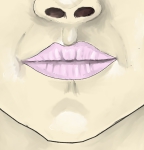 Lips
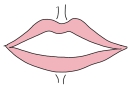 Lips (diagram)
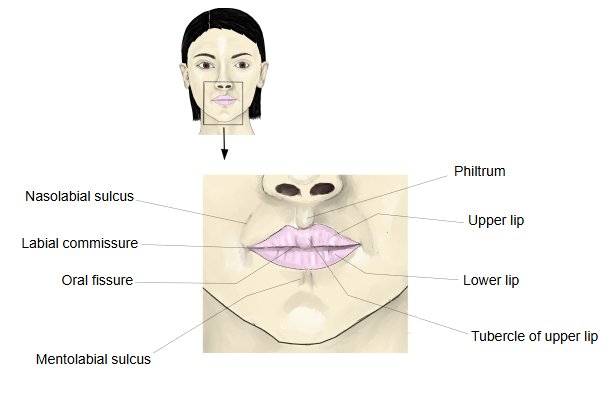
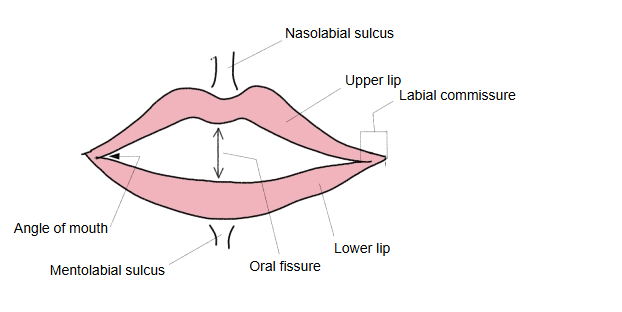
At the commissure the vermilion of the upper lip meets that of the lower lip. The commissure shapes facial expression, for example in smiling, and is of interest in dentistry and facial surgery. Cracking and inflammation of the skin here is called angular cheilitis.
Reference websites
[Wikipedia]
· Labial commissure of mouth, Wikipedia.
· Lip, Wikipedia.
[Websites with illustrations]
· Surface anatomy of the lips, with the oral commissure (Pocket Dentistry)

· Photograph of the lips with the right and left commissures labelled (Springer)

· The oral cavity: divisions and innervation (TeachMeAnatomy)
Related terms
References and sources
- Further reading: Labial commissure of mouth, Wikipedia.
- Further reading: Lip, Wikipedia.
- Federative International Programme for Anatomical Terminology (FIPAT). Terminologia Anatomica, 2nd ed. (TA2), 2019.