Lobes of liver (Latin: lobi hepatis)
Also called the hepatic lobes
The lobes of the liver are the parts of the liver whose names end in "lobe" when the liver is divided anatomically. There are four of them.
Anatomically: by its external appearance (surface landmarks)
Lobes of
the liver
the liver
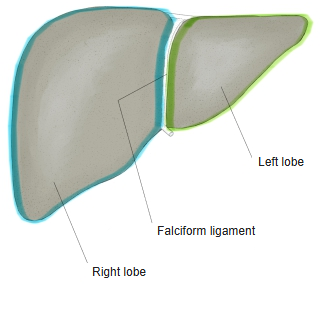
- Right lobe : to the right of the falciform ligament when the liver is seen from the front; the largest lobe.
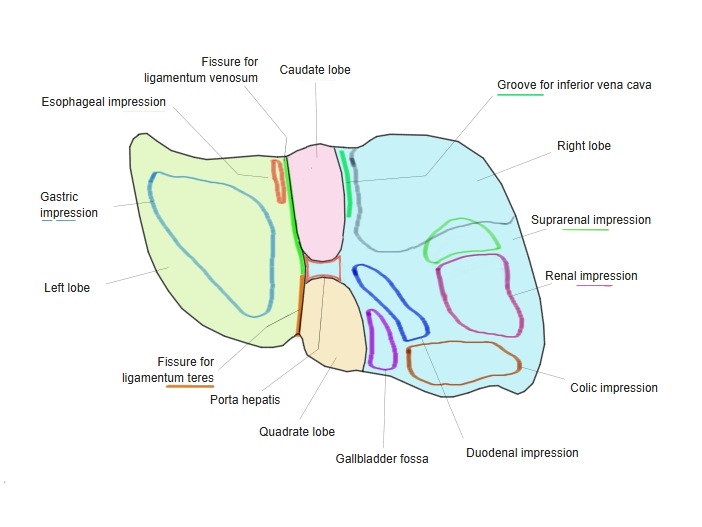
- Quadrate lobe : on the front part of the visceral surface, in front of the porta hepatis; usually regarded as part of the right lobe.
- Caudate lobe : on the back part of the visceral surface, behind the porta hepatis; functionally independent of both the right and left livers.
- Left lobe : to the left of the falciform ligament when the liver is seen from the front.
· This anatomical (surface) division differs from the functional division into right and left livers and the Couinaud hepatic segments, which follows the branching of the vessels and bile ducts.
· On the visceral surface, the quadrate and caudate lobes lie between the fissures for the ligamentum teres and ligamentum venosum on the left and the gallbladder fossa and groove for the inferior vena cava on the right, in front of and behind the porta hepatis.
 Liver (anterior view)
 Liver (visceral surface)
Related terms
References and sources
- Further reading: Lobes of liver, Wikipedia.
- Federative International Programme for Anatomical Terminology (FIPAT). Terminologia Anatomica, 2nd ed. (TA2), 2019.