Medial tubercle of talus (Latin: tuberculum mediale processus posterioris tali)
The posterior process of the talus is divided into medial and lateral parts by the groove for the tendon of flexor hallucis longus; the medial one is the medial tubercle. The deep posterior fibres of the deltoid ligament (posterior tibiotalar part) and the medial talocalcaneal ligament are attached to it.
- Lateral process of talus : a triangular projection pointing downwards and outwards.
- Posterior process of talus : divided by the groove for the tendon of flexor hallucis longus into two tubercles.
- Medial tubercle : the deltoid ligament (posterior tibiotalar part) and the medial talocalcaneal ligament are attached.
- Lateral tubercle : the posterior talofibular ligament and the posterior talocalcaneal ligament are attached.
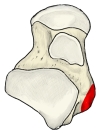 Right talus, medial tubercle (inferior)
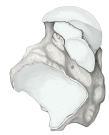 Right talus (inferior)
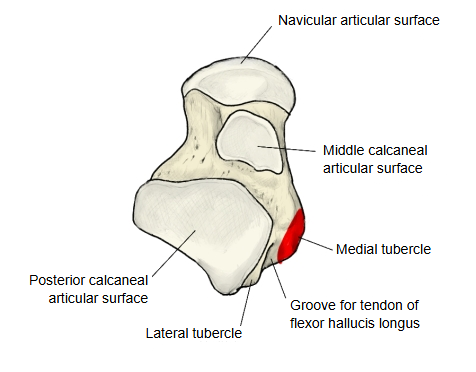
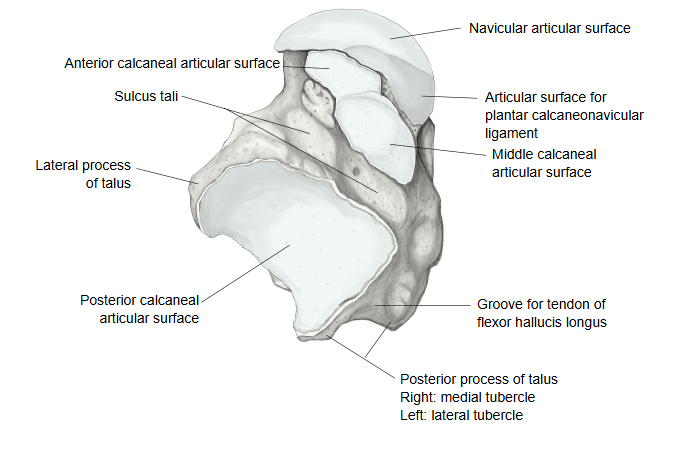
· It lies just behind the medial malleolar facet, below the posterior edge of the trochlea, and is usually the smaller of the two tubercles. The flexor hallucis longus tendon runs in the groove on its lateral side, between it and the lateral tubercle.
Reference websites
[Wikipedia]
· Talus bone, Wikipedia.
[Websites with illustrations]
· Left talus, seen from below (Gray's Anatomy, fig. 271) (Wikimedia Commons)

· Left talus, medial surface (Gray's Anatomy, fig. 272) (Wikimedia Commons)

· Talus (Kenhub)
Where it is found
Related terms
- Posterior process of talus
- Lateral tubercle of talus
- Groove for tendon of flexor hallucis longus
- Medial malleolar facet
- Body of talus
References and sources
- Further reading: Talus bone, Wikipedia.
- Federative International Programme for Anatomical Terminology (FIPAT). Terminologia Anatomica, 2nd ed. (TA2), 2019.