Mitochondrial matrix
Also called Matrix (of a mitochondrion)
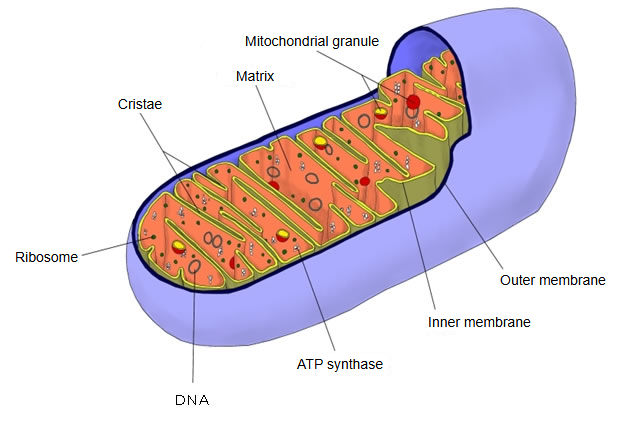
From the Latin word for womb (mater, mother). The word has different meanings in different fields; inside the body it usually means the material enclosed by the inner membrane of a mitochondrion. It contains the mitochondrion's own DNA, mitochondrial granules, ribosomes and the enzymes of the citric acid (TCA) cycle; ATP synthase in the inner membrane makes ATP on the matrix side.
Structure
of a
mitochondrion
of a
mitochondrion
- Outer membrane : a smooth, porous unit membrane (lipid bilayer).
- Intermembrane space : the narrow space between the outer and inner membranes (hydrogen ions = protons are pumped into it).
- Inner parts
- Inner membrane : a lipid bilayer folded inwards into cristae; it carries the electron transport chain (the energy-producing enzymes) and ATP synthase.
- Matrix
- DNA : the mitochondrion's own circular DNA, which holds genetic information.
- Ribosomes : the mitochondrion's own; they make 13 membrane proteins, which are built into the inner membrane.
- RNA : mainly the three kinds of RNA used in protein synthesis (mRNA, tRNA, rRNA).
- Enzymes and other contents : soluble enzymes of the citric acid (TCA) cycle and other proteins and ions needed for metabolism, all dissolved in water.
Related terms
References and sources
- Further reading: Mitochondrial matrix, Wikipedia.
- Federative International Programme for Anatomical Terminology (FIPAT). Terminologia Anatomica, 2nd ed. (TA2), 2019.