Ribosome (Latin: ribosoma)
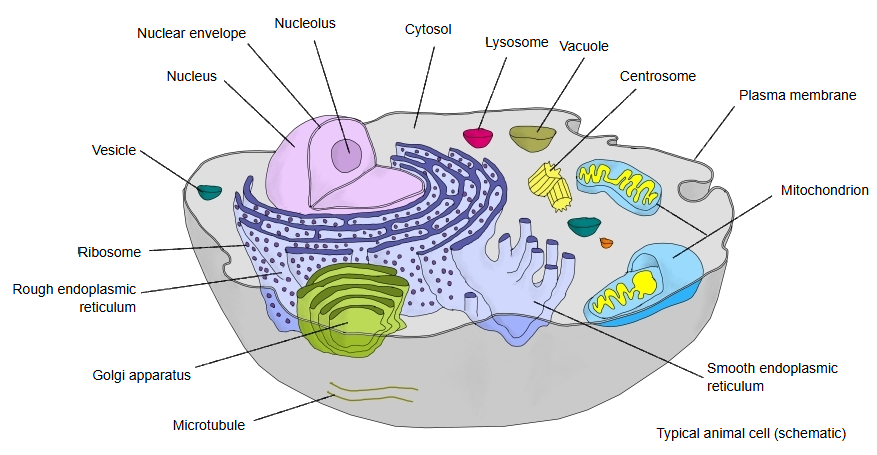
One of the structures inside every cell of our body (often counted among the organelles). Many are attached to the rough endoplasmic reticulum, and they make proteins.
More details
| Overview | Found in the cells of all living things. Like the mitochondria and the endoplasmic reticulum it is sometimes counted among the organelles and sometimes not, because it has no membrane (sources differ). | |
| 1 | Shape and size | Small granules, about 25–30 nm across (1 nm is one millionth of a millimetre). |
| 2 | Make-up | A complex of protein and RNA (ribonucleic acid, ribosomal RNA or rRNA). It consists of a large and a small subunit, which together contain about 80 proteins and 4 rRNAs (the figure below shows the human ribosome). The subunits are named after how fast they settle when spun in a centrifuge. The unit is the Svedberg (S); the larger the number, the faster the particle settles. In a centrifuge the subunits separate and settle at different rates: the large subunit is 60S and the small one 40S. One might expect 60 + 40 = 100, but the joined ribosome settles more slowly than the sum would suggest, at 80S: the "80S ribosome". The large subunit has about 47 proteins and 3 rRNAs, the small subunit about 33 proteins and 1 rRNA. The two subunits are made in the nucleolus, leave the nucleus separately and join only when they start making a protein. Mitochondria have their own smaller ribosomes: 55S in humans (39S + 28S); bacteria have 70S ribosomes (50S + 30S). Large subunit 60S + small subunit 40S ⇒ 80S ribosome (when they join, the particle becomes larger and its settling rate is not the simple sum). 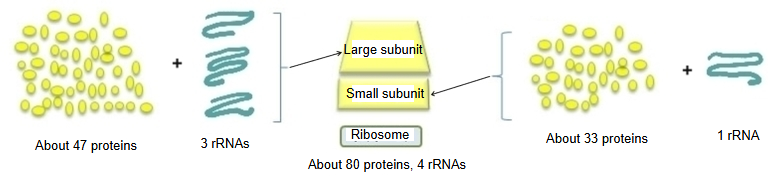 |
| 3 | Location | Mostly attached to the surface of the rough endoplasmic reticulum (rER): bound ribosomes. Others lie "free" in the cytoplasmic matrix (cytosol): free ribosomes. The mitochondria also contain their own ribosomes (55S in humans). |
| 4 | Function | Protein synthesis Ribosomes read the information carried by messenger RNA (mRNA) from the nucleus and join amino acids into a protein. Nucleus ⇒ mRNA ⇒ protein synthesis (ribosome) ⇒ secretion (endoplasmic reticulum) Bound ribosomes make proteins that are secreted, built into membranes or sent to lysosomes; these pass into the reticulum and on to the Golgi apparatus. Proteins made by free ribosomes are used inside the cell; many of them are enzymes. 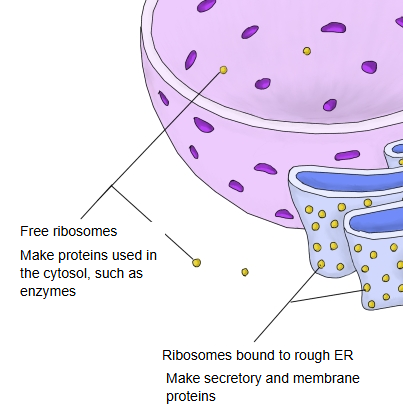 |
| 5 | Other | Polysome or polyribosome: several ribosomes attached to one messenger RNA ⇒ active protein synthesis. |
Cells that secrete much protein, such as gland cells and plasma cells, are packed with rough endoplasmic reticulum and stain strongly with basic dyes because of their RNA.
Reference websites
[Wikipedia]
· Ribosome, Wikipedia.
Videos
· The structure of the 70S ribosome (rotating model)
Related terms
- Golgi apparatus
- Cytoplasm
- Endoplasmic reticulum
- Organelle
- Nucleolus
- Cell nucleus
- Nuclear envelope
- Vesicle
- Secretory granule
- Plasma cell
References and sources
- Further reading: Ribosome, Wikipedia.
- Federative International Programme for Anatomical Terminology (FIPAT). Terminologia Anatomica, 2nd ed. (TA2), 2019.