Nucleosome
Overview
· A nucleosome is the smallest unit in which the long DNA of a eukaryotic cell is folded and packed inside the cell nucleus. It is also the basic unit of chromatin.
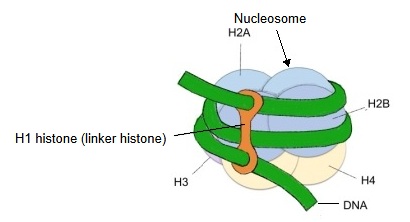
· Two each of the four histones H2A, H2B, H3 and H4 form a core of eight (the histone octamer). About 147 base pairs of DNA wind about 1.7 times around this core to make one nucleosome.
· A nucleosome is about 10 nm across, about five times the width of the DNA double helix (about 2 nm).
· Neighbouring nucleosomes are joined by a short stretch of DNA called linker DNA, whose length varies between cell types and species.
· Histone H1 (the linker histone) binds the linker DNA, keeps the spacing between nucleosomes and helps compact the chromatin, but it is not counted as part of the nucleosome.
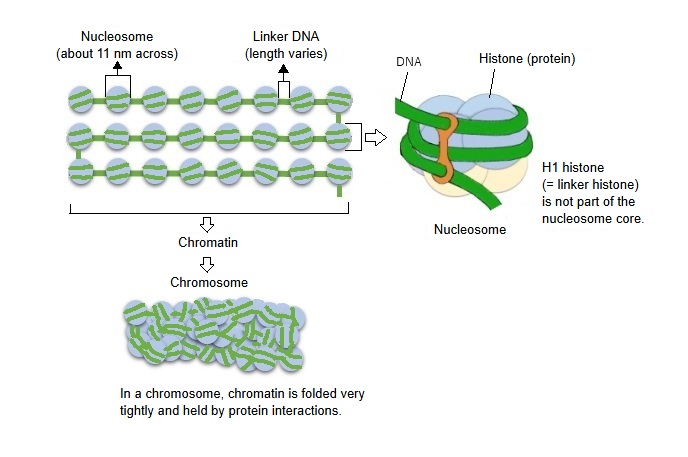
· Under the electron microscope a chain of nucleosomes looks like beads on a string (the 10-nm fibre). It folds further to form chromatin, which is folded very tightly into chromosomes during cell division.
· When nucleosomes are loosened, the DNA is read more easily; when they are packed tightly, it is read less easily. Chemical changes of the histones (such as methylation and acetylation) help control which genes are active.
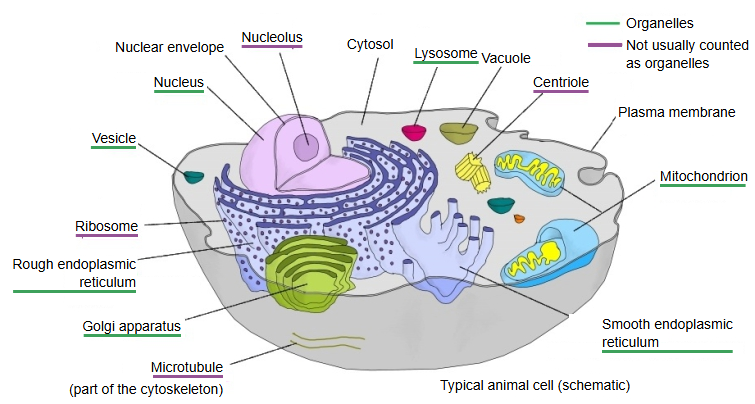
· Nucleosomes are found in the chromatin inside the cell nucleus.
[More details]
· See the Chromatin, Histone and Cell nucleus pages.
Reference websites
[Wikipedia]
· Nucleosome, Wikipedia.
Related terms
References and sources
- Further reading: Nucleosome, Wikipedia.
- Federative International Programme for Anatomical Terminology (FIPAT). Terminologia Anatomica, 2nd ed. (TA2), 2019.