Chromatin
Overview
Mainly histones
· It is the structure that stores the genetic information and keeps it ready to be used when needed.
· DNA is wound around groups of eight histone molecules to form nucleosomes, joined by linker DNA like beads on a string; this string is folded further into more compact fibres and loops.
· Loosely packed chromatin (euchromatin) is generally active in transcription; densely packed chromatin (heterochromatin) is largely inactive. Before cell division the chromatin condenses further into the visible chromosomes.
Structure
of the
nucleus
of the
nucleus
- Nuclear envelope : the double membrane that covers the whole nucleus; nuclear pores in it let substances pass
- Nuclear contents
- Nucleoplasm : the fluid that fills the nucleus, containing enzymes, nucleotides and other substances
- Chromatin : the complex of DNA and histones; holds the genetic information and allows its expression
- Nucleolus : synthesis of rRNA, assembly of the ribosomal subunits
- Nuclear skeleton : protein fibres (such as the nuclear lamina) that support the shape of the nucleus and help to organize the chromatin
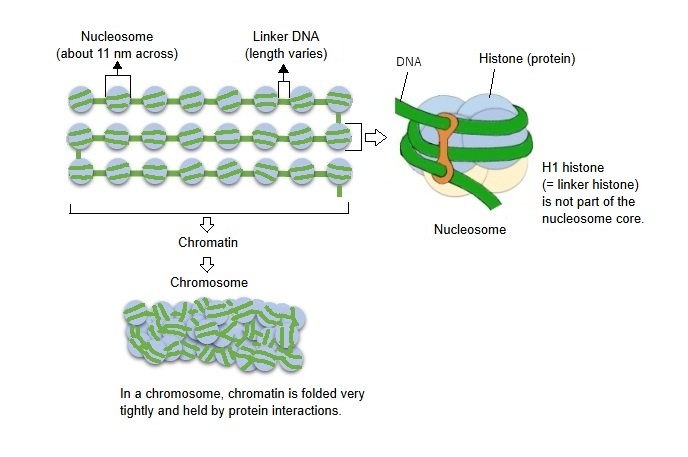
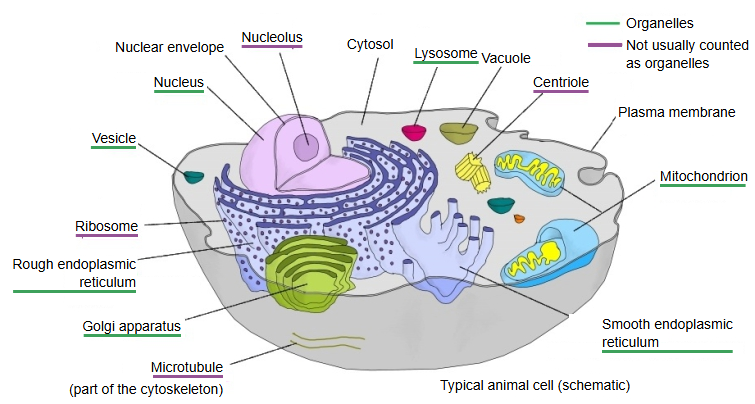
Table of organelles
| Organelles (cell organelles) | ||
|---|---|---|
| 1 | Nucleus | Storage of DNA, control of transcription |
| 2 | Mitochondria | ATP production, energy metabolism |
| 3 | Rough endoplasmic reticulum | (RER) Synthesis of proteins for secretion and of membrane proteins |
| 4 | Smooth endoplasmic reticulum | (SER) Lipid synthesis, storage of Ca2+, detoxification |
| 5 | Golgi apparatus | Modification, sorting and transport of proteins |
| 6 | Lysosome | Breakdown and recycling |
| 7 | Peroxisome | Oxidation reactions (hydrogen peroxide), fatty-acid metabolism |
| 8 | Endosome | Endocytic pathway |
| 9 | Secretory vesicle | Release of substances from the cell |
| Not usually counted as organelles (no membrane) | ||
| 1 | Ribosome | Protein synthesis |
| 2 | Cytoskeleton | Keeping the shape of the cell, transport |
| 3 | Centrosome (centrioles) | Formation of the spindle |
| 4 | Nucleolus | Synthesis of rRNA, assembly of ribosomes |
Structure
of the
cell
of the
cell
- Cell membrane : phospholipid bilayer, membrane proteins, sugar chains
- Cytoplasm
- Cytosol : water, electrolytes, metabolic enzymes, free amino acids, metabolic intermediates
- Organelles : mitochondria, endoplasmic reticulum, centrosome (no membrane), Golgi apparatus, lysosomes, peroxisomes, vesicles
- Cytoskeleton (no membrane) : microtubules, actin filaments, intermediate filaments
- Nucleus : nuclear envelope, nucleoplasm, chromatin, nucleolus (no membrane)
- Note : the structures marked 'no membrane' are not usually counted as organelles, but like organelles they have particular functions
Reference websites
[Wikipedia]
· Chromatin, Wikipedia.
Related terms
References and sources
- Further reading: Chromatin, Wikipedia.
- Federative International Programme for Anatomical Terminology (FIPAT). Terminologia Anatomica, 2nd ed. (TA2), 2019.