Olfactory glomerulus (Latin: glomerulus olfactorius)
Also called the glomerulus of the olfactory bulb
· Diameter: about 50-120 µm (in mammals).
· Number: sources differ for the human olfactory bulb, from about 1,000 to several thousand. The number falls with age, and in old age some glomeruli are lost.
· Structure: it can be divided into the part formed by the endings of the olfactory cells and the part formed by the other cells.
· It is linked to other glomeruli by small inhibitory nerve cells around it (periglomerular cells).
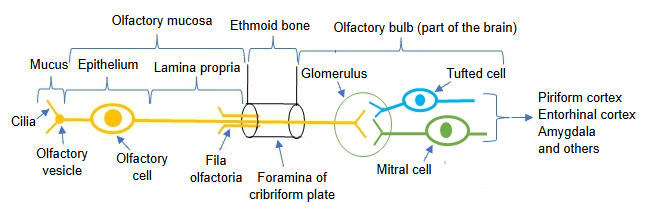
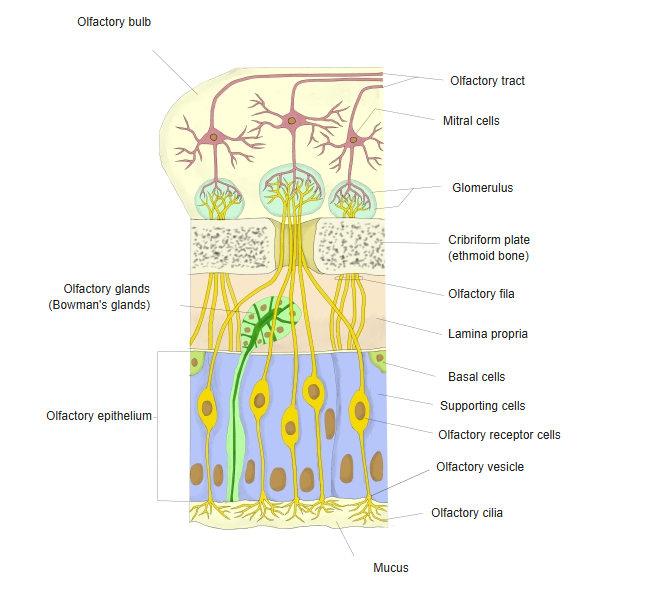
In each glomerulus the incoming axons of the olfactory cells (fila olfactoria, which together form the olfactory nerve) make their first synapses with the dendrites of the mitral cells and tufted cells, the main output neurons of the bulb. Each glomerulus receives the axons of receptor cells that carry the same type of odorant receptor, so the pattern of active glomeruli encodes the odour. The axons of the mitral and tufted cells leave the bulb in the olfactory tract for the piriform cortex, entorhinal cortex, amygdala and other olfactory areas. The renal glomerulus is a different structure (a tuft of capillaries in the kidney); only the name is shared.
Reference websites
[Wikipedia]
· Glomerulus (olfaction), Wikipedia.
[Websites with illustrations]
· Gray's Anatomy fig. 755: the olfactory bulb (figure) (Wikimedia Commons)

· Olfactory sensory neurons innervating olfactory glomeruli (figure) (Wikimedia Commons)

Related terms
- Olfactory bulb
- Fila olfactoria
- Olfactory receptor cells
- Olfactory epithelium
- Nasal mucosa
- Olfactory glands
References and sources
- Further reading: Glomerulus (olfaction), Wikipedia.
- Federative International Programme for Anatomical Terminology (FIPAT). Terminologia Anatomica, 2nd ed. (TA2), 2019.