Polypeptide
· The word is sometimes used almost as a synonym of protein.
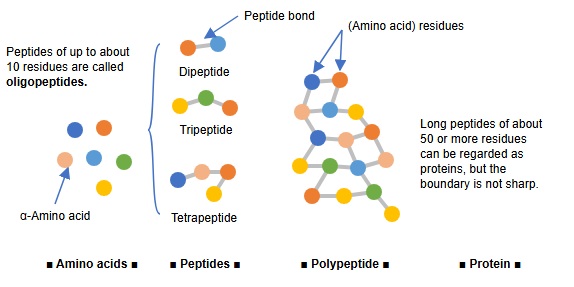
· There is no strict definition. Chains of up to about 10 amino acids are often called oligopeptides and longer ones polypeptides, but sources differ (some put the limit at about 20).
· A polypeptide is a long, continuous, unbranched chain. A protein consists of one or more polypeptides folded into a functional shape, often bound to other molecules such as coenzymes, other proteins or nucleic acids.
· Amino acids built into a peptide chain are called residues; one water molecule is released for each peptide bond formed. Except in ring-shaped (cyclic) peptides, the chain has an N-terminal end (amino group) and a C-terminal end (carboxyl group).
Reference websites
[Wikipedia]
· Peptide, Wikipedia.
Related terms
References and sources
- Further reading: Peptide, Wikipedia.
- Federative International Programme for Anatomical Terminology (FIPAT). Terminologia Anatomica, 2nd ed. (TA2), 2019.