Tuberosity of cuboid (Latin: tuberositas ossis cuboidei)
A raised ridge on the plantar (lower) surface of the cuboid, one of the tarsal bones, to which the long plantar ligament (its deep part) is attached. Sources describe it in slightly different ways.
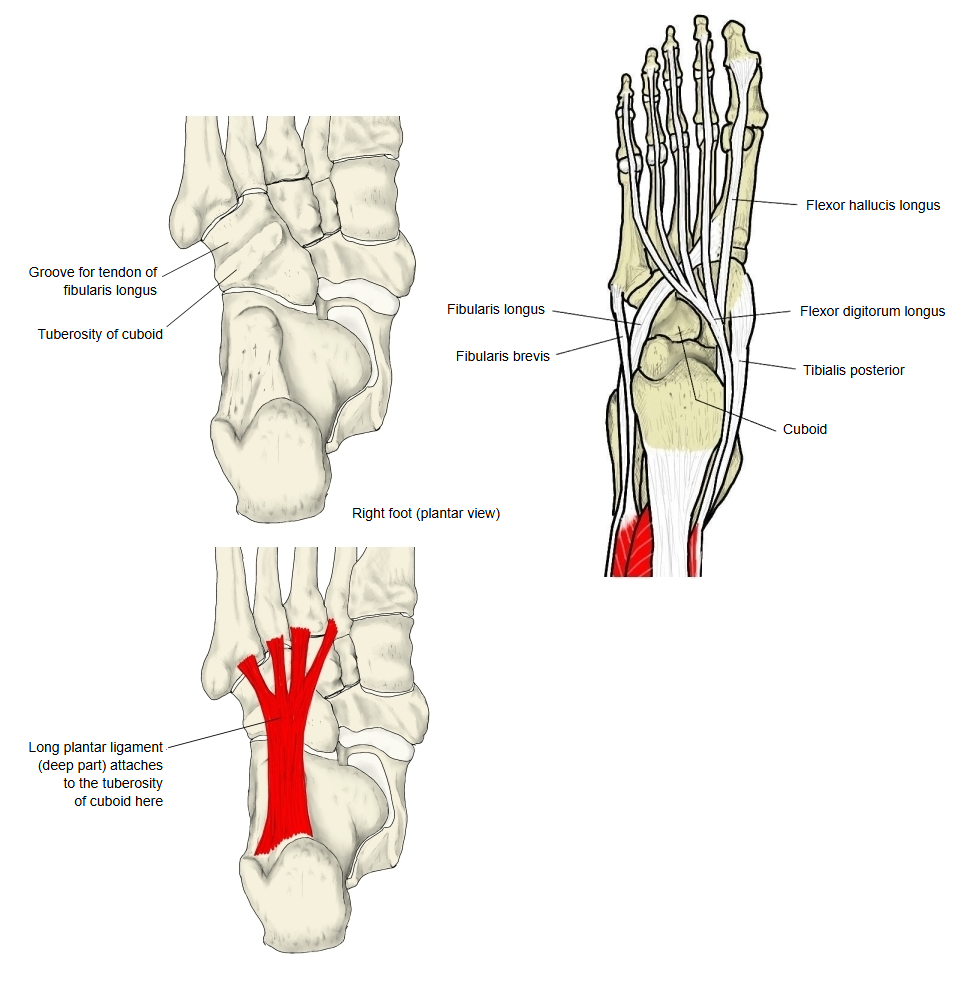
Most textbooks place it just behind the groove for the tendon of fibularis longus: it runs obliquely across the underside of the cuboid and forms the back wall of the groove, and the long plantar ligament attaches to it.
Some texts give the name only to the lateral half of the high ridge that forms the back edge of the groove. Does that mean the medial half is not called the tuberosity of the cuboid? The texts do not say.
Older texts describe a prominent transverse ridge on the lower surface of the cuboid as the tuberosity and say that the groove for the tendon of fibularis longus runs over it. This puts the groove and the tuberosity in a rather different relation from the usual description, in which the groove lies in front of the ridge.
The deep fibres of the long plantar ligament attach to the tuberosity; its superficial fibres pass on to the bases of the metatarsals. The lateral end of the ridge often carries a small facet for the sesamoid bone in the fibularis longus tendon (the os peroneum).
Where it is found
Related terms
- Cuboid
- Groove for tendon of fibularis longus
- Calcaneal process of cuboid
- Calcaneocuboid joint
- Calcaneus
- Cuneocuboid joint
References and sources
- Further reading: Cuboid bone, Wikipedia.
- Further reading: Long plantar ligament, Wikipedia.
- Federative International Programme for Anatomical Terminology (FIPAT). Terminologia Anatomica, 2nd ed. (TA2), 2019.