Venous blood
Also called the deoxygenated blood
What is venous blood?
The path of venous blood
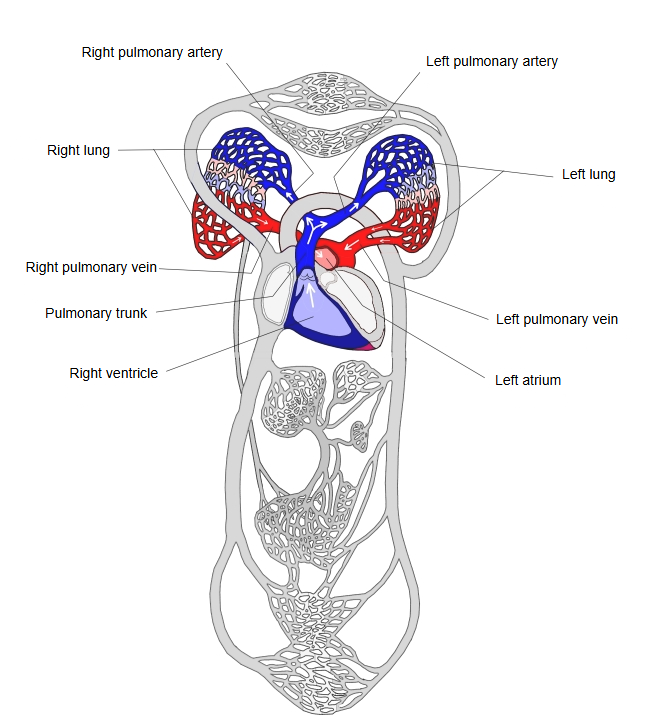
Note: the pulmonary trunk and the left and right pulmonary arteries carry venous blood.
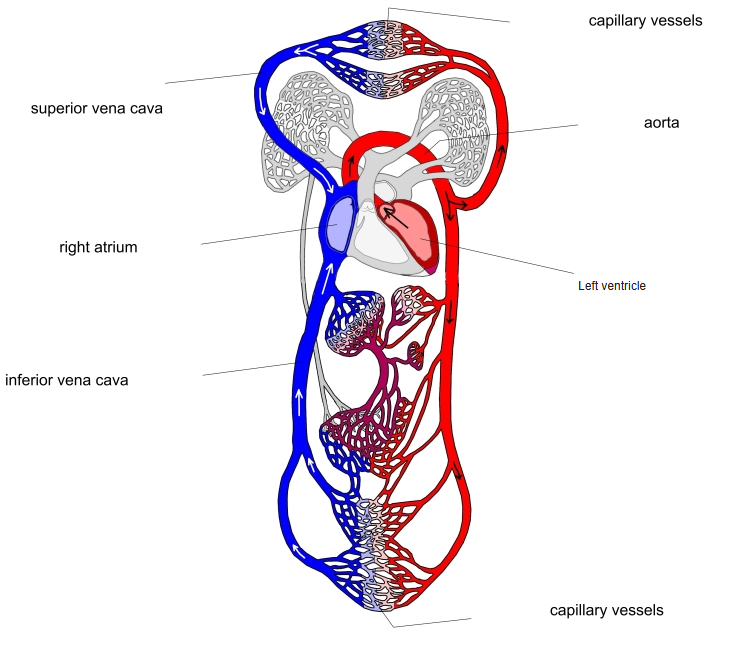
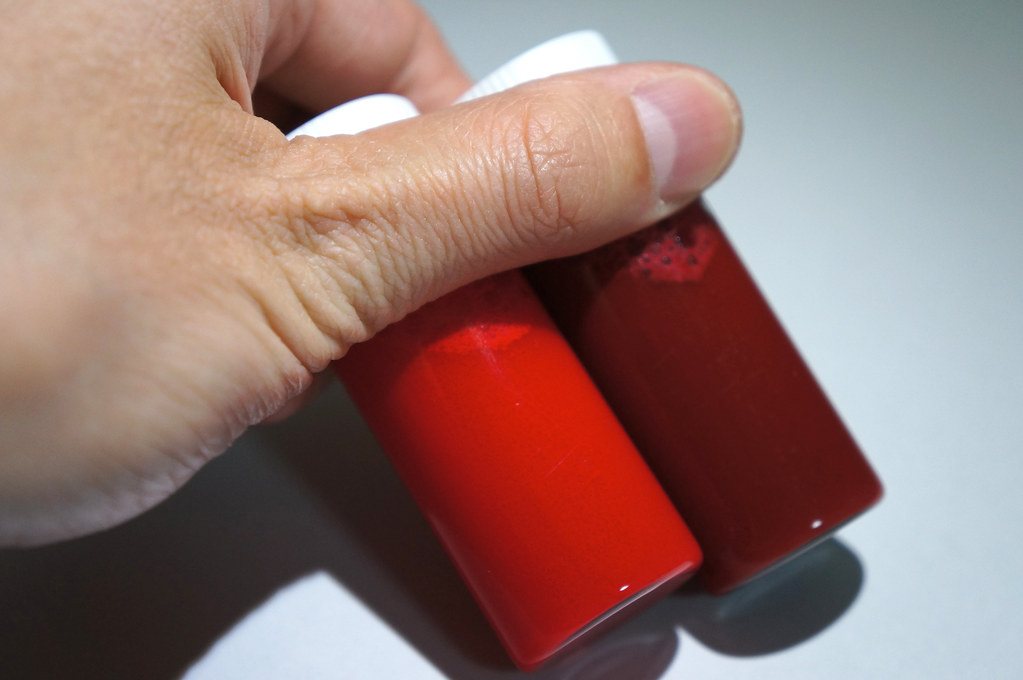
Venous blood is darker red than arterial blood, with a lower oxygen content and pH and more carbon dioxide and waste products such as urea. In humans it returns from the capillaries through the veins and the superior and inferior vena cava to the right atrium. The right ventricle pumps it through the pulmonary trunk and pulmonary arteries to the lungs, where it gives off carbon dioxide and takes up oxygen, and it returns to the heart as arterial blood in the pulmonary veins.
So in the pulmonary circulation the names are reversed: the arteries carry venous blood and the veins carry arterial blood. This follows because arteries and veins are named by the direction of flow (away from or towards the heart), but blood is named by its oxygen content. The same applies to arterial blood.
Most laboratory blood tests use venous blood taken from a superficial vein; blood gas tests use arterial blood.
 Pulmonary circulation (diagram)
 Systemic circulation (diagram)
Reference websites
[Wikipedia]
· Venous blood, Wikipedia.
· Pulmonary artery, Wikipedia.
[Websites with illustrations]
· Venous and arterial blood (photograph) (Wikimedia Commons)

· Arterial and venous blood (photograph) (Flickr)
Related terms
- Blood
- Pulmonary circulation
- Systemic circulation
- Right atrium
- Right ventricle
- Pulmonary arteries
- Superior vena cava
References and sources
- Further reading: Venous blood, Wikipedia.
- Federative International Programme for Anatomical Terminology (FIPAT). Terminologia Anatomica, 2nd ed. (TA2), 2019.